The best compact jump starters for motorcycles in 2026 offer reliable power in a portable design, ensuring riders are never stranded by a dead battery. Models like the NOCO Boost Sport GB20 (500A peak) and Battery Tender 600 AMP (600A peak) provide sufficient power for most motorcycles, typically ranging from 200 to 500 peak amps. These devices utilize advanced lithium-ion batteries, offering lightweight convenience and essential safety features like spark-proof connections and reverse polarity protection, making them indispensable tools for any motorcyclist.
Jump Starter: An Essential Lifesaver for Motorcyclists
A jump starter is a self-contained power pack designed to revive a dead vehicle battery quickly and efficiently. For motorcyclists, a compact portable jump starter is an indispensable tool, offering independence and peace of mind on every journey. Unlike traditional jumper cables that require a second vehicle, these units allow you to boost your bike’s battery solo, saving you from inconvenient waits and potential hazards.
Modern compact jump starters predominantly utilize lithium-ion or lithium polymer battery technology. This choice of battery chemistry makes them incredibly lightweight, small enough to fit in a saddlebag or even a jacket pocket, and capable of delivering high burst currents. Beyond their primary function of starting your engine, many models double as versatile power banks, equipped with USB ports to charge your phone, tablet, or other electronic devices. Their integrated LED flashlights often feature multiple modes, proving invaluable for roadside emergencies or working in low-light conditions.
How to Choose the Right Compact Jump Starter for Your Motorcycle
Selecting the ideal jump starter for your motorcycle involves understanding a few key specifications and features. It’s not just about raw power; suitability for your bike’s electrical system and your specific riding needs is paramount.
Capacity and Starting Current
When evaluating jump starters, two numbers are critical: peak amps and battery capacity (measured in mAh). Peak amps (or cranking amps in some specifications) refer to the maximum electrical current the unit can deliver in a brief surge, which is what’s needed to kick-start a stubborn engine. For most motorcycles, an output of 200 to 500 peak amps is generally sufficient to get the engine turning. However, if you ride a larger touring or adventure bike with a bigger engine, or if you plan to use the jump starter for a small car as well, a unit offering 600 to 1000 peak amps might be a more versatile choice. While some powerful car jump starters can boast 2000A or more, your motorcycle will only draw the current it needs, so excessive amperage isn’t inherently damaging, but a lower-rated, compact unit is often a better physical fit for motorcycle carry.
Battery capacity (mAh or milliampere-hours) indicates how much energy the internal battery holds. A higher mAh rating means the jump starter can provide more jump starts on a single charge or offer extended power bank functionality. For typical motorcycle use, a capacity ranging from 6,000 mAh to 18,000 mAh strikes a good balance between portability and utility.
Battery Type
|
Our Picks for the Best Jump Starter in 2026
As an Amazon Associate I earn from qualifying purchases.
|
||
| Num | Product | Action |
|---|---|---|
| 1 | KeenPower 6000A Super Capacitor Battery-Less Jump Starter, Built-in 6 * 3000F Supercapacitor, No Traditional Battery |

|
| 2 | Tire Inflator Portable Air Compressor, 12V Car Jump Starter, 150PSI & 28000mAh Air Pump with Air Blower, Digital Pressure Gauge and LED Light, Electric Air Pump for Car, Motorcycle, Balls, Bike Pump |
|
| 3 | ANCEL BS200 Super Starter - Permanent Connected Starting System with Super Capacitor, Car Battery Jump Booster & Health Monitor via App, -40℉~176℉ in-Cabin Jump Box for 3.0L Vehicles |
|
| 4 | NOCO Boost X GBX155: 4250A UltraSafe Jump Starter – 12V Lithium Battery Booster Pack, Portable Jump Box, Power Bank & Jumper Cables - for 10.0L Gas and 8.0L Diesel Engines |
|
| 5 | Portable Car Jump Starter with Air Compressor for Emergencies,3000A Peak and 150 PSI Max,for 12L Gas & 10L Diesel Engines,LCD Display,LED Light |
|
| 6 | Roar Pedal Super Capacitor Jump Starter, No Need Pre-Charge No Battery 12V Portable Car Jump Starter for All 12V Gas and Diesel Car, Portable Jump Box with Display |
|
| 7 | NOCO Boost X GBX55: 1750A UltraSafe Jump Starter – 12V Lithium Battery Booster Pack, Portable Jump Box, Power Bank & Jumper Cables - for 7.5L Gas and 5.0L Diesel Engines |
|
| 8 | Jump Starter with Air Compressor, 6000A 150PSI Car Battery Jump Starter (10.0 Gas/8.0L Diesel) Battery Jumper Starter Portable 12V Jump Box with Jumper Cables, LED Light, LED Display |
|
| 9 | Tire Inflator Portable Air Compressor with Digitally Display Pressure Gauge 20000mA, Car Air Compressor Pump with Jump Starter 150PSI, 14.8 V Car Battery Jump Starter Portable |
|
| 10 | Tire Inflator Portable Air Compressor & Car Jump Starter, Cordless Air Pump with LED Light & Pressure Gauge for Auto,Motorcycles,Bikes,Balls. |
|
The vast majority of compact jump starters today rely on advanced lithium-ion or lithium polymer batteries. These battery types offer significant advantages over older, heavier lead-acid models. They are considerably lighter and smaller, making them perfectly suited for carrying on a motorcycle. Lithium batteries also boast excellent charge retention, meaning they can hold a charge for many months, ensuring they’re ready when you need them most. Many modern lithium-based jump starters are designed to perform reliably even in colder temperatures, a crucial consideration for riders in diverse climates.
Additional Features
Beyond core starting power, many compact jump starters come packed with supplementary features that enhance their utility and safety. Safety protections are paramount; look for spark-proof technology and reverse polarity protection, which prevent damage to both the jump starter and your motorcycle’s electrical system in case of incorrect connection. Over-current, short-circuit, and thermal shutdown protections also add layers of safety.
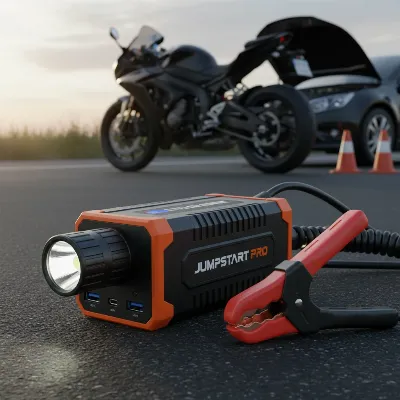 Compact motorcycle jump starter with LED flashlight, USB ports, and robust clamps highlighting safety features
Other valuable features include USB charging ports, which improve your jump starter into a portable power bank for your phone, GPS, or other gadgets. An integrated LED flashlight is extremely useful for nighttime breakdowns, with some models offering strobe or SOS modes for emergencies. Some premium jump starters may even offer water resistance (e.g., IP65 rating), providing extra durability against the elements. Consider also the quality of the clamps – insulated, spring-loaded clamps with angled tips can make connecting to tight battery terminals much easier.
Brand Reputation and Price
Investing in a jump starter from a reputable brand can save you headaches down the road. Established names like NOCO, Battery Tender, Anti-Gravity, and Ride Power have a proven track record for reliability, safety, and customer support. While these brands might come with a slightly higher price tag, the peace of mind and performance they offer are often worth the investment. Prices for quality compact motorcycle jump starters typically range from $60 to $150, depending on power, capacity, and extra features. Balancing your budget with your specific needs and prioritizing safety features from a trusted manufacturer is always a wise approach.
Comparing the Top 5 Best Compact Motorcycle Jump Starters of 2026
Choosing the right jump starter can be challenging with so many options available. Here’s a detailed comparison of five top-rated compact jump starters, specifically selected for their performance, portability, and suitability for motorcycles in 2026.
| Model | Peak Amps (or Constant Amps) | Battery Capacity (mAh) | Key Features | Pros | Cons |
|---|---|---|---|---|---|
| NOCO Boost Sport GB20 | 500A Peak | 4,650 mAh | Spark-proof connections, reverse polarity protection, 100-lumen LED flashlight, rugged, water-resistant (IP65) | Ultra-compact and lightweight, specifically designed for smaller engines, durable and weather-resistant. | Lower capacity than some, fewer power bank features than larger units, best suited for motorcycles only. |
| NOCO Boost Plus GB40 | 1000A Peak | 6,500 mAh | Spark-proof, reverse polarity protection, 100-lumen LED with 7 modes, doubles as power bank, versatile clamps. | Industry standard, powerful enough for motorcycles and small cars, excellent safety features, very reliable. | Slightly larger than GB20, higher price point. |
| Battery Tender 600 AMP | 600A Peak | 6,400 mAh | Reverse polarity, short circuit prevention, spark-proof, USB charging ports, compact. | Cost-effective, good balance of power and size for motorcycles, includes essential safety features. | May not have the advanced LED modes or ruggedness of NOCO units. |
| Ride Power Portable | 600A Constant | 10,000 mAh | Two USB Type-A ports, 3-way charging cable, 12V adapter, built-in flashlight with strobe. | Very lightweight (13 oz), high capacity for multiple uses, excellent power bank functionality, versatile charging. | Clamps might be less robust than heavy-duty options, 600A constant is good for bikes but not larger cars. |
| Anti-Gravity XP-1 | 400A Constant | 12,000 mAh | USB Type-A and USB-C ports, compact design, comes with carrying case and accessories. | High capacity for extended power bank use, ideal for motorcycles only, very portable. | Lower cranking power compared to some, may struggle with very large motorcycle engines or cold starts. |
Safe and Effective Use of Your Motorcycle Jump Starter
Using a jump starter correctly is crucial for both your safety and the longevity of your motorcycle’s electrical system. Always refer to your jump starter’s owner’s manual for specific instructions, as procedures can vary slightly between models.
Here are the general steps for safely jump-starting your motorcycle:
- Preparation: Ensure your jump starter is adequately charged. Turn off your motorcycle’s ignition and any accessories.
- Connect Red Clamp: Attach the red (positive) clamp of the jump starter to the positive (+) terminal of your motorcycle’s dead battery. Ensure a firm, clean connection.
- Connect Black Clamp: Attach the black (negative) clamp to a suitable ground point on your motorcycle chassis, away from the battery and fuel lines. A sturdy, unpainted metal part of the frame is usually ideal. Some jump starters recommend connecting directly to the negative terminal of the battery; check your manual.
- Activate Jump Starter: Turn on your jump starter. Many modern units have intelligent safety features that will only activate once a correct connection is detected.
- Start Motorcycle: Attempt to start your motorcycle. If it doesn’t start immediately, wait a few seconds (as per your jump starter’s instructions) before trying again to avoid overheating the starter motor.
- Disconnect Black Clamp: Once the motorcycle starts, first disconnect the black (negative) clamp from the chassis/battery.
- Disconnect Red Clamp: Then disconnect the red (positive) clamp from the battery.
Safety Reminders:
- Always wear appropriate eye protection and gloves.
- Never allow the clamps to touch each other when the jump starter is active.
- Do not use a jump starter that shows signs of damage.
- Avoid jump-starting a frozen battery, as it can explode.
- After a successful jump, let your motorcycle run for at least 15-20 minutes to allow the alternator to recharge the battery.
To prolong the life of your jump starter, store it in a cool, dry place and recharge it periodically, typically every 3-6 months, even if not used. This ensures it’s always ready for an emergency.
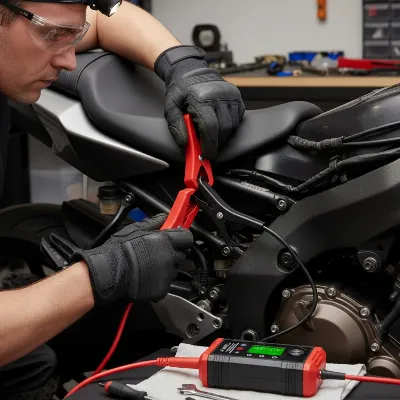 A person safely connecting a compact jump starter to a motorcycle battery, emphasizing proper clamp placement and safety gear
Tips and Tricks for Motorcycle Jump Starter Use
Maximizing the effectiveness of your compact jump starter goes beyond just knowing the connection steps. A few savvy tips can enhance your experience and ensure you’re always prepared.
One common issue is starting a motorcycle in cold weather. Low temperatures significantly reduce battery performance. If your bike is struggling in the cold, give the jump starter a moment to “wake up” the battery before attempting to crank the engine. Some high-end jump starters even feature pre-heating technology to help in extreme cold. Another useful trick is to ensure you have a clean connection. Corroded battery terminals can impede current flow, making it harder for the jump starter to do its job. A quick clean with a wire brush before connecting can make a big difference.
Consider the dual functionality of your jump starter. Many models, especially the compact lithium-ion units, double as robust power banks. Don’t just save it for a dead battery; use its USB ports to charge your phone, camera, or action cam during long rides or camping trips. This can reduce the number of devices you need to carry. Lastly, to check your motorcycle’s owner’s manual for any specific battery or electrical system quirks, especially if you have a modern fuel-injected bike with sensitive electronics. Some manufacturers might have recommendations or warnings regarding external power sources. Being knowledgeable about your specific bike model can prevent unexpected issues.
Motorcycle Jump Starters – Frequently Asked Questions
How many amps do I need for my motorcycle jump starter?
Most motorcycles require between 150 and 300 peak amps to start. A compact jump starter with 200-500 peak amps is generally sufficient, providing enough power without being excessively large or heavy for motorcycle carry.
Can I use a car jump starter on my motorcycle?
Yes, you can typically use a car jump starter on a motorcycle, provided it’s a 12V system compatible unit. However, avoid using a running car with jumper cables, as voltage spikes can potentially damage sensitive motorcycle electronics. A dedicated portable jump starter is safer.
How often should I recharge my jump starter?
It’s recommended to recharge your portable jump starter every 3 to 6 months, even if it hasn’t been used. This prevents the internal battery from deeply discharging, which can reduce its lifespan and ensure it’s always ready for an emergency.
Are lithium jump starters safe to use?
Yes, modern lithium jump starters are very safe. Reputable brands incorporate multiple safety features such as spark-proof connections, reverse polarity protection, over-current protection, and thermal shutdown, which prevent damage from incorrect use.
What is the difference between peak amps and cranking amps?
Peak amps refer to the maximum burst of current a jump starter can deliver for a very short duration. Cranking amps (CCA, Cold Cranking Amps) indicate the sustained current a battery can supply at 0°F for 30 seconds while maintaining a specific voltage. For portable jump starters, peak amps are more commonly advertised as they represent the initial surge needed to start an engine.
Conclusion
A compact jump starter is more than just a gadget; it’s an investment in your freedom and peace of mind on two wheels. As motorcycle technology evolves, so does the sophistication and reliability of these essential roadside companions. For 2026, the market offers exceptional portable solutions, designed to handle everything from a quick boost for a daily commuter to providing vital power for long-distance adventurers. By prioritizing factors like appropriate peak amperage, a robust battery type, essential safety features, and a reputable brand, you can confidently select a model that perfectly matches your motorcycle and riding style. Don’t let a dead battery dictate your journey—empower yourself with the right jump starter and hit the road knowing you’re always prepared. What will be your next adventure with your newfound power?
Frequently Asked Questions
How many amps do I need for my motorcycle jump starter?
Most motorcycles require between 150 and 300 peak amps to start. A compact jump starter with 200-500 peak amps is generally sufficient, providing enough power without being excessively large or heavy for motorcycle carry.
Can I use a car jump starter on my motorcycle?
Yes, you can typically use a car jump starter on a motorcycle, provided it's a 12V system compatible unit. However, avoid using a running car with jumper cables, as voltage spikes can potentially damage sensitive motorcycle electronics. A dedicated portable jump starter is safer.
How often should I recharge my jump starter?
It's recommended to recharge your portable jump starter every 3 to 6 months, even if it hasn't been used. This prevents the internal battery from deeply discharging, which can reduce its lifespan and ensure it's always ready for an emergency.
Are lithium jump starters safe to use?
Yes, modern lithium jump starters are very safe. Reputable brands incorporate multiple safety features such as spark-proof connections, reverse polarity protection, over-current protection, and thermal shutdown, which prevent damage from incorrect use.
What is the difference between peak amps and cranking amps?
Peak amps refer to the maximum burst of current a jump starter can deliver for a very short duration. Cranking amps (CCA, Cold Cranking Amps) indicate the sustained current a battery can supply at 0u00b0F for 30 seconds while maintaining a specific voltage. For portable jump starters, peak amps are more commonly advertised as they represent the initial surge needed to start an engine.
How to Safely Jump Start Your Motorcycle
Follow these steps to safely and effectively jump start your motorcycle using a compact jump starter.
Ensure your jump starter is adequately charged before use. Turn off your motorcycle's ignition and any accessories to prevent electrical surges or damage during the jump-starting process.
Attach the red (positive) clamp of the jump starter to the positive (+) terminal of your motorcycle's dead battery. Make sure the connection is firm and clean to ensure proper current flow.
Attach the black (negative) clamp to a suitable ground point on your motorcycle chassis, away from the battery and fuel lines. A sturdy, unpainted metal part of the frame is usually ideal. Consult your jump starter's manual for specific recommendations.
Turn on your jump starter; many modern units have intelligent safety features that activate only when a correct connection is detected. Attempt to start your motorcycle. If it doesn't start immediately, wait a few seconds as per your jump starter's instructions before trying again to avoid overheating the starter motor.
Once the motorcycle starts, first disconnect the black (negative) clamp from the chassis/battery. Then, disconnect the red (positive) clamp from the battery. Always disconnect in this order to prevent sparks.

I picked up the NOCO Boost Sport GB20 after reading about it, and it’s been a game-changer. My old bike sometimes struggles to start in the cold, and this little unit fires it right up every time. It’s super compact, fits easily under my seat, and the spark-proof connections really give me peace of mind. Definitely recommend it for any rider.
Got one of these compact jump starters, not one of the brands mentioned, but similar specs. It works for my motorcycle, but the battery life on the unit itself isn’t as long as I hoped. I have to remember to charge it more often than I thought I would. Still, it’s better than being stuck with a dead battery.
I’ve been using the Battery Tender 600 AMP for a few weeks now, and it’s solid. It’s powerful enough for my cruiser, and I like knowing I won’t get stranded. My only minor gripe is that the carrying case feels a little flimsy compared to the unit itself, but the device works perfectly. Great to have that reverse polarity protection too.
This is exactly what I needed! The convenience of a lithium-ion battery in such a small package is amazing. I used to carry bulky cables, but this compact jump starter makes everything so much easier. It’s an essential tool for my long rides, and I feel much safer knowing I have it.