Storing a lithium jump starter safely in a hot car requires strategic placement and heat mitigation to prevent battery degradation and potential safety risks. The interior of a parked car can reach 131 to 172 degrees Fahrenheit when outside temperatures are 80-100°F, far exceeding the ideal storage range of 59-86°F (15-30°C) for most lithium-ion batteries. Implementing smart storage solutions like placing it in the trunk, covering it with insulation, or using reflective sun shades can significantly extend its lifespan and ensure reliability.
Understanding the Risks: Why Heat is a Lithium Jump Starter’s Enemy
Heat is undeniably the primary adversary of any battery, and lithium jump starters are particularly vulnerable. The internal chemistry of lithium-ion batteries is highly sensitive to elevated temperatures. When consistently exposed to heat, the chemical reactions inside the battery accelerate, leading to a faster degradation of its components. This degradation manifests as a reduced capacity to hold a charge, a shorter overall lifespan for the device, and diminished performance when you need it for an emergency start.
A significant concern with prolonged heat exposure is the potential for thermal runaway. While modern lithium jump starters, especially high-quality models, are equipped with sophisticated Battery Management Systems (BMS) to mitigate these risks, extreme and sustained heat can still push a battery beyond its safe limits. Thermal runaway is a self-accelerating chain reaction where increasing temperature causes further temperature increases, potentially leading to smoke, fire, or even explosion. It’s important to recognize that the interior of a parked car can become an oven. When the outside temperature is between 80 and 100 degrees Fahrenheit, the inside of a vehicle can easily soar to 131 to 172 degrees Fahrenheit, and even higher in direct sunlight. These temperatures often exceed the recommended maximum storage and operating temperatures for many lithium batteries, making proper storage crucial for both safety and device longevity. For shop curated automotive emergency on this site.
Optimal Conditions for Lithium Jump Starter Longevity
To ensure your lithium jump starter remains a reliable emergency tool for years to come, understanding and maintaining optimal storage conditions is paramount. These conditions primarily revolve around temperature and the device’s state of charge.
Ideal Temperature and Humidity Ranges
For most lithium-ion batteries, including those found in jump starters, the ideal storage temperature falls within a relatively narrow range. Aim for a stable environment between 59 and 86 degrees Fahrenheit (15-30 degrees Celsius). Storing it below 77 degrees Fahrenheit (25 degrees Celsius) is even better for preserving its capacity and preventing premature self-discharge. Contrast this with the potentially scorching temperatures inside a parked car, which can frequently exceed 140 degrees Fahrenheit (60 degrees Celsius), pushing batteries into a rapid degradation zone. Beyond temperature, humidity also plays a role. A relative humidity of around 50% is generally considered best, as excessive humidity can risk corrosion or even short circuits from condensation over time. Keeping your jump starter in a climate-controlled environment whenever possible, rather than constantly leaving it in an uncontrolled vehicle interior, will significantly extend its life.
The Importance of Charge Level
|
Our Picks for the Best Jump Starter in 2026
As an Amazon Associate I earn from qualifying purchases.
|
||
| Num | Product | Action |
|---|---|---|
| 1 | Portable Car Jump Starter with Air Compressor for Emergencies,3000A Peak and 150 PSI Max,for 12L Gas & 10L Diesel Engines,LCD Display,LED Light |

|
| 2 | Jump Starter with Air Compressor, 6000A 150PSI Car Battery Jump Starter (10.0 Gas/8.0L Diesel) Battery Jumper Starter Portable 12V Jump Box with Jumper Cables, LED Light, LED Display |
|
| 3 | ANCEL BS200 Super Starter - Permanent Connected Starting System with Super Capacitor, Car Battery Jump Booster & Health Monitor via App, -40℉~176℉ in-Cabin Jump Box for 3.0L Vehicles |
|
| 4 | KeenPower 6000A Super Capacitor Battery-Less Jump Starter, Built-in 6 * 3000F Supercapacitor, No Traditional Battery |
|
| 5 | Roar Pedal Super Capacitor Jump Starter, No Need Pre-Charge No Battery 12V Portable Car Jump Starter for All 12V Gas and Diesel Car, Portable Jump Box with Display |
|
| 6 | Tire Inflator Portable Air Compressor with Digitally Display Pressure Gauge 20000mA, Car Air Compressor Pump with Jump Starter 150PSI, 14.8 V Car Battery Jump Starter Portable |
|
| 7 | NOCO Boost X GBX155: 4250A UltraSafe Jump Starter – 12V Lithium Battery Booster Pack, Portable Jump Box, Power Bank & Jumper Cables - for 10.0L Gas and 8.0L Diesel Engines |
|
| 8 | Tire Inflator Portable Air Compressor & Car Jump Starter, Cordless Air Pump with LED Light & Pressure Gauge for Auto,Motorcycles,Bikes,Balls. |
|
| 9 | Tire Inflator Portable Air Compressor, 12V Car Jump Starter, 150PSI & 28000mAh Air Pump with Air Blower, Digital Pressure Gauge and LED Light, Electric Air Pump for Car, Motorcycle, Balls, Bike Pump |
|
| 10 | NOCO Boost X GBX55: 1750A UltraSafe Jump Starter – 12V Lithium Battery Booster Pack, Portable Jump Box, Power Bank & Jumper Cables - for 7.5L Gas and 5.0L Diesel Engines |
|
The state of charge (SOC) is another critical factor for lithium battery health during storage, especially when heat is involved. For optimal longevity and to minimize stress on the battery cells, it’s best to store your lithium jump starter at a charge level between 40% and 60%. Storing a fully charged battery (100% SOC) at high temperatures is particularly damaging, accelerating capacity loss and shortening its lifespan. While a high-quality BMS can prevent overcharging during use, prolonged storage at full charge in hot conditions still puts undue stress on the cells. Conversely, storing a battery that is almost completely depleted (below 30% SOC) is also detrimental, as it can lead to deep discharge and irreversible damage. Periodically checking and adjusting your jump starter’s charge level to this sweet spot—especially before long periods of hot weather storage—will contribute significantly to its long-term health.
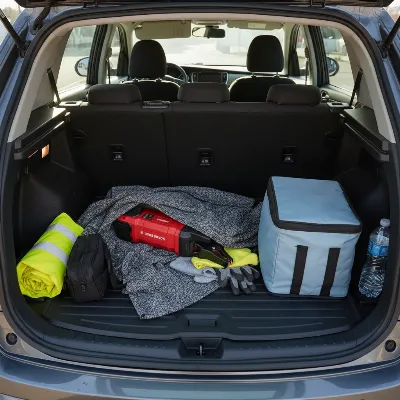 A red lithium jump starter inside a car's trunk, partially covered by a blanket, illustrating safe storage in a hot car.
Smart Storage Solutions for Hot Car Environments
Even with the best intentions, it’s not always practical to remove your jump starter from your car every time you park. Implementing smart storage strategies within your vehicle can significantly mitigate the harmful effects of heat, safeguarding your device and ensuring it’s ready when you need it.
Strategic Placement Within Your Vehicle
Where you store your jump starter in the car makes a considerable difference. The glove compartment, while convenient, is often one of the hottest spots in a vehicle, especially since heat rises and it’s frequently exposed to direct sunlight through the windshield. A better location is usually the trunk or a lower, less exposed area of the cabin. Storing the jump starter as low down as possible in the trunk helps, as the coolest air tends to sink, and it’s generally further from direct sunlight. Covering the device with a blanket, towel, or even placing it inside a larger bag can provide an extra layer of insulation against radiant heat and direct sunlight. Avoid placing it on dark surfaces that absorb and radiate heat more intensely.
DIY Heat Mitigation Strategies
For those living in extremely hot climates, some DIY solutions can further protect your jump starter. Consider using an insulated bag or a small cooler (without ice or water) as a protective container. These can offer a buffer against external temperature fluctuations. The goal is to slow down the rate at which the jump starter heats up and help it retain a more stable internal temperature. Another strategy, particularly when parking for extended periods, is to use reflective sun shades on your car windows. These shades are highly effective at reducing the interior temperature of your vehicle, thereby lowering the ambient temperature for your jump starter. In regions where temperatures consistently climb into triple digits, the most effective DIY strategy might be to simply remove the jump starter from the car when you get home, bringing it indoors to a climate-controlled environment. This simple act can dramatically extend its lifespan.
Leveraging Your Jump Starter’s Built-in Safeguards and Maintenance
Modern lithium jump starters aren’t just powerful; they’re also designed with internal safeguards to protect themselves and their users. Understanding these features and combining them with regular maintenance practices will optimize your device’s performance and longevity.
Battery Management Systems (BMS) and Material Design
High-quality lithium jump starters are equipped with a sophisticated Battery Management System (BMS). This electronic brain constantly monitors critical parameters such as voltage, current, and—crucially for hot environments—temperature. The BMS acts as a guardian, preventing overcharging, over-discharging, and protecting against extreme temperatures during both operation and storage. Some advanced models may even feature high-temperature-resistant materials in their construction, allowing them to endure slightly hotter conditions than standard devices. If a jump starter detects that its internal temperature exceeds a safe threshold, its BMS might trigger a protective shutdown or display an error code, signaling that it needs to cool down before use. Always refer to your specific model’s manual to understand its temperature limits and error indicators.
Regular Checks and Best Practices
Even with a robust BMS, proactive maintenance is key to keeping your jump starter in top condition. Periodically inspect the device for any signs of physical damage, swelling, or leaks, which could indicate internal battery issues exacerbated by heat. Regularly check the jump starter’s charge level and, if needed, charge or discharge it to maintain the recommended 40-60% storage charge. If you notice your jump starter feels excessively warm to the touch, even when not in use, it’s a clear sign that it might be stored in too hot an environment and needs relocation. Following the manufacturer’s guidelines for charging, usage, and storage temperatures is essential. These recommendations are tailored to the specific battery chemistry and design of your device, providing the most accurate advice for its care.
Lithium Jump Starter FAQs
Is it safe to leave a lithium jump starter in my car all year round?
While many lithium jump starters are designed to be portable for emergencies, continuous year-round storage in a car, especially in areas with extreme temperature fluctuations, is not ideal. High heat significantly degrades the battery and shortens its lifespan. It’s safer to bring it indoors during peak hot or cold seasons.
What happens if my jump starter gets too hot?
If a lithium jump starter gets too hot, its internal battery components will degrade faster, leading to reduced capacity and a shorter lifespan. In extreme cases, particularly without proper BMS, overheating can potentially lead to thermal runaway, which involves smoke, fire, or even an explosion.
How often should I check my jump starter if it’s stored in a hot car?
If you must store your jump starter in a hot car, check its charge level monthly to ensure it’s within the 40-60% optimal storage range. Also, regularly inspect the device for any signs of physical damage, swelling, or unusual heat when touching it. If you live in an extremely hot climate, checking more frequently or simply bringing it indoors is advisable.
Are all lithium jump starters equally sensitive to heat?
No, not all lithium jump starters are equally sensitive. Jump starters using Lithium Iron Phosphate (LiFePO4) chemistry generally offer greater thermal stability and can withstand higher temperatures before thermal runaway compared to standard Lithium-ion (Li-ion) batteries. Always check your device’s specifications, though exact chemistry can be hard to determine for all products.
Can an overheated jump starter explode?
While rare due to built-in safety features like Battery Management Systems (BMS), an overheated lithium jump starter does carry a risk of thermal runaway, which can lead to fire or explosion. This risk increases significantly with sustained exposure to extreme temperatures, especially if the battery is fully charged or damaged.
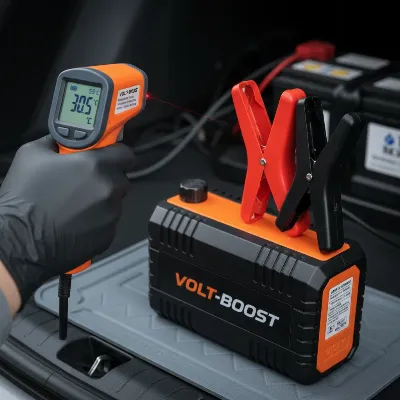 A hand checking the temperature of a lithium jump starter with a thermometer, emphasizing safe storage practices.
While the convenience of keeping a lithium jump starter readily accessible in your car is undeniable, understanding and mitigating the risks associated with extreme heat is crucial. By recognizing that high temperatures can severely degrade battery life and potentially pose safety hazards, you can take proactive steps to protect your investment. Prioritizing storage in cooler areas of your vehicle, utilizing simple DIY insulation techniques, and maintaining an optimal 40-60% charge level are key practices. Trusting in your device’s built-in Battery Management System and adhering to regular maintenance checks will ensure your jump starter remains a reliable and safe tool for years to come. Don’t let your essential emergency tool become a victim of the heat; prioritize its safe storage. What simple change will you make today to extend the life of your lithium jump starter?
Frequently Asked Questions
Is it safe to leave a lithium jump starter in my car all year round?
No, continuous year-round storage in a car, especially in areas with extreme temperature fluctuations, is not ideal for a lithium jump starter. High heat significantly degrades the battery and shortens its lifespan. It's safer to bring it indoors during peak hot or cold seasons.
What happens if my jump starter gets too hot?
If a lithium jump starter gets too hot, its internal battery components will degrade faster, leading to reduced capacity and a shorter lifespan. In extreme cases, particularly without proper Battery Management Systems (BMS), overheating can potentially lead to thermal runaway, which involves smoke, fire, or even an explosion.
How often should I check my jump starter if it's stored in a hot car?
If you must store your jump starter in a hot car, check its charge level monthly to ensure it's within the 40-60% optimal storage range. Also, regularly inspect the device for any signs of physical damage, swelling, or unusual heat when touching it. If you live in an extremely hot climate, checking more frequently or simply bringing it indoors is advisable.
Are all lithium jump starters equally sensitive to heat?
No, not all lithium jump starters are equally sensitive. Jump starters using Lithium Iron Phosphate (LiFePO4) chemistry generally offer greater thermal stability and can withstand higher temperatures before thermal runaway compared to standard Lithium-ion (Li-ion) batteries. Always check your device's specifications, though exact chemistry can be hard to determine for all products.
Can an overheated jump starter explode?
While rare due to built-in safety features like Battery Management Systems (BMS), an overheated lithium jump starter does carry a risk of thermal runaway, which can lead to fire or explosion. This risk increases significantly with sustained exposure to extreme temperatures, especially if the battery is fully charged or damaged.
Safely Store a Lithium Jump Starter in a Hot Car
Protect your lithium jump starter from extreme heat in your car to extend its lifespan and ensure it's ready for emergencies.
Avoid the glove compartment, which is often the hottest spot. Instead, store the jump starter as low down as possible in the trunk or a less exposed area of the cabin. This helps keep it away from direct sunlight and higher temperatures.
Cover your jump starter with a blanket, towel, or place it inside a larger bag. This provides an extra layer of insulation against radiant heat and direct sunlight, slowing down the rate at which it heats up.
Store your lithium jump starter at a charge level between 40% and 60%. Storing it fully charged or nearly depleted in hot conditions can accelerate capacity loss and cause irreversible damage. Periodically check and adjust the charge.
When parking for extended periods, use reflective sun shades on your car windows. These shades are highly effective at reducing the interior temperature of your vehicle, thereby lowering the ambient temperature for your jump starter.
For regions with consistently triple-digit temperatures, the most effective strategy is to remove the jump starter from the car when you get home. Bringing it indoors to a climate-controlled environment can dramatically extend its lifespan.

Excellent advice! I had no idea that a parked car could get up to 172 degrees inside. That’s insane! I’ve been worried about my new Schumacher jump starter degrading, so the tips on strategic placement are exactly what I needed. Definitely moving it out of direct sunlight in the back seat.
This was really helpful! I never considered the specific temperature ranges for lithium-ion batteries. I’ve been keeping my portable power pack in the glove compartment, which probably isn’t ideal. I’m going to try moving it to the trunk and maybe even wrapping it in a small blanket for insulation, especially with summer coming up.
I used to just toss my jump starter under the seat, but after reading about how hot car interiors get, I’m definitely rethinking that. The tip about using reflective sun shades makes so much sense for keeping the trunk cooler. My NOCO Boost X has been a lifesaver, and I want to make sure it lasts.
Good info on why heat is bad for these things. I wish there were more specific product recommendations for insulated bags or covers. It’s hard to know what’s actually effective for keeping the temperature down when the car is baking in 100-degree weather. My old jump starter died way too fast, probably from this.