No, you cannot safely jump start a car without a battery. Attempting to jump start a vehicle that lacks a battery is not only ineffective but also carries significant risks of severe electrical damage to your vehicle’s sensitive components. The car battery is an indispensable component that stabilizes the entire electrical network, absorbing voltage fluctuations and power surges from external jump sources. Without its buffering action, the vehicle’s electronics become vulnerable to irreparable harm.
The car battery is more than just a power source for starting; it’s a vital component that stabilizes the entire electrical network. Without its buffering action, the vehicle’s sensitive electronics become vulnerable to dangerous voltage fluctuations and power surges from external jump sources. This article clarifies why a battery is essential for any jump starting process, details the potential hazards of attempting to bypass it, and guides you through the correct, safe procedures for jump starting a car that has a dead battery, ensuring you can get back on the road without causing costly harm.
The Critical Role of Your Car Battery: Why You Can’t Jump Start Without It
A car battery is far more than a simple power cell; it’s the cornerstone of your vehicle’s electrical stability and starting mechanism. Its primary role is to provide the immense burst of power required to spin the starter motor, which in turn cranks the engine. Beyond this initial surge, the battery acts as a crucial voltage regulator and buffer for the entire electrical system. It absorbs electrical spikes from the alternator and ensures a steady voltage supply to all components, from the engine control unit (ECU) and sensors to the infotainment system and lights.
Attempting to jump start a car without a battery installed exposes the vehicle to extreme danger. Without the battery to stabilize incoming voltage, the electrical system lacks its fundamental foundation. This leaves sensitive components directly exposed to unregulated power surges from the donor vehicle or jump starter. The alternator, wiring harnesses, fuses, and delicate electronic control units (ECUs) are not designed to handle such direct, unfiltered power. The consequences can range from blown fuses and fried wiring to permanent damage to the alternator itself and expensive, irreparable harm to the ECU and other critical computer systems, potentially leading to a fire. The distinction between a dead battery and a missing battery is vital: a dead battery, even if completely discharged, still provides the necessary electrical presence and buffering capacity to facilitate a safe jump start. A missing battery offers no such protection, rendering the attempt both futile and hazardous.
Jump Starting Your Car: The Safe and Effective Way (With a Dead Battery)
When your car won’t start due to a dead battery, a jump starter or a donor vehicle is the solution. Unlike trying to start a car with no battery at all, jump starting a vehicle with a discharged battery is a common and safe procedure, provided you follow the correct steps and use appropriate equipment. The goal is to provide enough temporary power to the starter motor to crank the engine, allowing the car’s alternator to take over and begin recharging the battery once the engine is running.
There are primarily two ways to jump start a car with a dead battery: using another vehicle and jumper cables, or employing a portable jump starter. Both methods aim to deliver the necessary current to get the engine running. However, the choice of equipment and the proper execution of the steps are paramount to ensure safety and prevent damage to either vehicle’s electrical system. Modern jump starters often include built-in safety features like reverse polarity protection, which can add an extra layer of security, making them an excellent choice for roadside emergencies.
Jump Starter: Effective Car Starting Solution
|
Our Picks for the Best Jump Starter in 2026
As an Amazon Associate I earn from qualifying purchases.
|
||
| Num | Product | Action |
|---|---|---|
| 1 | ANCEL BS200 Super Starter - Permanent Connected Starting System with Super Capacitor, Car Battery Jump Booster & Health Monitor via App, -40℉~176℉ in-Cabin Jump Box for 3.0L Vehicles |

|
| 2 | KeenPower 6000A Super Capacitor Battery-Less Jump Starter, Built-in 6 * 3000F Supercapacitor, No Traditional Battery |
|
| 3 | Tire Inflator Portable Air Compressor & Car Jump Starter, Cordless Air Pump with LED Light & Pressure Gauge for Auto,Motorcycles,Bikes,Balls. |
|
| 4 | Tire Inflator Portable Air Compressor with Digitally Display Pressure Gauge 20000mA, Car Air Compressor Pump with Jump Starter 150PSI, 14.8 V Car Battery Jump Starter Portable |
|
| 5 | Tire Inflator Portable Air Compressor, 12V Car Jump Starter, 150PSI & 28000mAh Air Pump with Air Blower, Digital Pressure Gauge and LED Light, Electric Air Pump for Car, Motorcycle, Balls, Bike Pump |
|
| 6 | Roar Pedal Super Capacitor Jump Starter, No Need Pre-Charge No Battery 12V Portable Car Jump Starter for All 12V Gas and Diesel Car, Portable Jump Box with Display |
|
| 7 | Portable Car Jump Starter with Air Compressor for Emergencies,3000A Peak and 150 PSI Max,for 12L Gas & 10L Diesel Engines,LCD Display,LED Light |
|
| 8 | NOCO Boost X GBX155: 4250A UltraSafe Jump Starter – 12V Lithium Battery Booster Pack, Portable Jump Box, Power Bank & Jumper Cables - for 10.0L Gas and 8.0L Diesel Engines |
|
| 9 | Jump Starter with Air Compressor, 6000A 150PSI Car Battery Jump Starter (10.0 Gas/8.0L Diesel) Battery Jumper Starter Portable 12V Jump Box with Jumper Cables, LED Light, LED Display |
|
| 10 | NOCO Boost X GBX55: 1750A UltraSafe Jump Starter – 12V Lithium Battery Booster Pack, Portable Jump Box, Power Bank & Jumper Cables - for 7.5L Gas and 5.0L Diesel Engines |
|
A jump starter is an invaluable tool for any vehicle owner, providing an independent solution to revive a dead battery. These devices are designed to deliver a high burst of current to the starter motor, bypassing the need for a second vehicle. Portable jump starters have evolved significantly, becoming more compact, powerful, and user-friendly, making them a preferred choice for many.
Types of Jump Starters:
- Portable Lithium-ion Jump Starters: These are the most common and popular type today. They are compact, lightweight, and typically feature internal lithium-ion batteries. Many include additional functionalities like USB charging ports for mobile devices, LED flashlights, and advanced safety protections. They are excellent for personal vehicles and smaller trucks.
- Lead-Acid Battery Jump Starters: Often larger and heavier, these units contain a traditional lead-acid battery. They tend to offer higher peak amperage and are sometimes preferred for larger vehicles or commercial use due to their robust power delivery. However, they require more maintenance, such as periodic recharging, and can be less portable.
The importance of a jump starter lies in its ability to quickly and independently restore power to a dead car battery. It offers peace of mind, knowing you have a reliable solution at hand, whether you’re at home, work, or stranded on a remote road.
Guide to Choosing the Right Jump Starter for Your Vehicle
Selecting the appropriate jump starter is crucial for ensuring it can effectively and safely start your vehicle. Several key specifications and features differentiate models, and understanding them will help you make an informed decision tailored to your specific needs.
Capacity and Starting Current
The most critical specifications for a jump starter are its capacity (measured in mAh or Ah) and its starting current ratings, typically expressed as Peak Amps and Cold Cranking Amps (CCA).
- Peak Amps (PA): This is the maximum instantaneous current a jump starter can deliver for a very short burst. While a higher peak amp rating might seem better, it doesn’t always reflect sustained starting power.
- Cranking Amps (CA) or Starting Amps: This refers to the sustained current the jump starter can provide for a continuous period, usually 30 seconds, at 32°F (0°C). This is a more realistic measure of its ability to turn over an engine.
- Cold Cranking Amps (CCA): This is the gold standard for measuring a jump starter’s ability to start an engine in cold weather, specifically the current it can deliver for 30 seconds at 0°F (-18°C) while maintaining a minimum voltage. For typical passenger cars, 400-600 CCA is often sufficient, but larger engines, diesel vehicles, or those operating in extremely cold climates may require 1000 CCA or more.
- Capacity (mAh or Ah): This indicates the internal battery’s energy storage, affecting how many jump starts you can get on a single charge or how long it can power accessories. A higher mAh/Ah means greater endurance. For most vehicles, 10,000 mAh is a practical minimum.
To determine the right capacity and current, consider your vehicle’s engine size (smaller engines need less, larger engines and diesels need more), fuel type (diesel engines require significantly more power than gasoline engines), and the typical climate you operate in (cold weather demands higher CCA). Most passenger vehicles benefit from jump starters with 1000-1500 Peak Amps, while SUVs and trucks often require 1500-2000 Peak Amps, and heavy-duty or diesel vehicles might need 2000 Peak Amps or more.
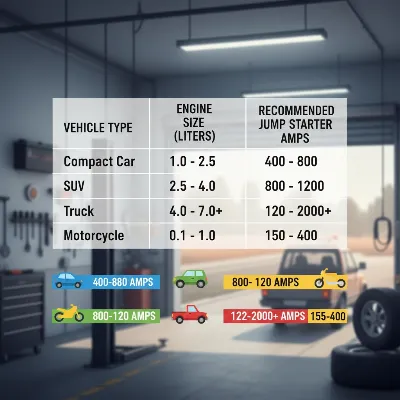 Infographic showing recommended jump starter amp ratings for various vehicle types and engine sizes.
Battery Type
The type of internal battery significantly impacts the jump starter’s performance, size, and lifespan.
- Lithium-ion (Li-ion): These are lightweight, compact, and hold a charge for a long time without significant self-discharge. They offer high power density, making them very efficient. Modern lithium-ion jump starters are equipped with advanced safety features and are suitable for most personal and light commercial vehicles.
- Lead-Acid: These units are typically larger, heavier, and more robust, often found in traditional “box-style” jump starters. They can deliver very high peak currents and are sometimes preferred for heavy-duty applications. However, they are less portable and require more frequent recharging to maintain their health.
Lithium-ion jump starters are generally recommended for their convenience, portability, and excellent performance for everyday use.
Additional Features
Beyond core performance, several supplementary features enhance the utility and safety of a jump starter.
- Built-in Flashlight: Essential for nighttime emergencies, providing visibility for connections and safety.
- USB Ports: Allow you to charge smartphones, tablets, and other electronic devices, turning the jump starter into a versatile power bank.
- 12V DC Outlet: Some models offer a 12V output, useful for powering small accessories like tire inflators or portable coolers.
- Safety Protections: Look for features such as reverse polarity protection (prevents damage if cables are connected incorrectly), spark-proof technology, over-current protection, short-circuit protection, over-voltage protection, and over-temperature protection. These are critical for safe operation.
- Digital Display: Provides real-time information on battery charge level and operational status.
- Durability and Build Quality: A robust casing can withstand accidental drops and harsh weather conditions.
Prioritizing safety features is paramount, as they protect both the user and the vehicle’s electrical system from potential damage. Additional features enhance convenience and functionality, making the jump starter a more valuable tool.
Brands and Pricing
The market offers a wide array of jump starters from various reputable brands, each with different price points. Well-known brands often invest more in research, development, and quality control, leading to more reliable products with better safety features.
Reputable Brands: Brands like NOCO, Schumacher, Audew, and Clore Automotive are frequently recommended for their performance and reliability.Price Range: Prices can vary significantly based on capacity, features, and brand. Basic portable lithium-ion jump starters might range from $50-$100, while high-capacity, feature-rich models designed for larger vehicles or professional use can cost $150-$300 or more.
Consider your budget, but prioritize performance and safety features over simply choosing the cheapest option. A reliable jump starter is an investment in your peace of mind and vehicle’s well-being.
How to Use a Jump Starter Safely and Effectively
Using a jump starter correctly is crucial to avoid injury or damage to your vehicle. Always refer to your vehicle’s owner’s manual and the jump starter’s instructions for specific guidance, as procedures can vary slightly.
Step-by-Step Guide to Safe Jump Starting (with a Dead Battery):
-
Preparation is Key:
- Ensure both vehicles (if using jumper cables) are turned off. For a portable jump starter, make sure it is adequately charged.
- Engage the parking brake on both vehicles.
- Put both vehicles in neutral (manual) or park (automatic).
- Turn off all electrical accessories (lights, radio, AC) in the dead vehicle.
- Wear safety glasses and gloves to protect against battery acid or sparks.
- Ensure good ventilation if working in an enclosed space.
-
Connecting the Cables (Jumper Cables or Portable Jump Starter):
- Positive to Positive: Connect the red (positive) clamp of the jump starter (or jumper cables) to the positive (+) terminal of the dead car’s battery.
- Positive to Donor (if using cables): If using jumper cables, connect the other red (positive) clamp to the positive (+) terminal of the donor vehicle’s battery.
- Negative to Donor (if using cables): Connect the black (negative) clamp of the jumper cables to the negative (-) terminal of the donor vehicle’s battery.
- Negative to Ground (Safe Grounding): Connect the remaining black (negative) clamp of the jump starter (or jumper cables) to a clean, unpainted metal part of the dead car’s engine block or frame, away from the battery and moving parts. This is known as a ground connection and helps prevent sparks near the battery, where hydrogen gas can accumulate. Never connect the negative clamp directly to the negative terminal of the dead battery.
-
Initiating the Jump Start:
- If using a donor vehicle, start its engine and let it run for a few minutes to build up a charge in the dead battery.
- Activate your portable jump starter (if applicable).
- Attempt to start the dead car. If it doesn’t start immediately, wait a minute or two before trying again, allowing the battery to receive more charge. Do not crank for more than 5-10 seconds at a time to prevent overheating the starter motor.
-
Disconnecting the Cables (Crucial Order):
- Once the dead car starts, let it run for a few minutes.
- Negative from Ground: Disconnect the black (negative) clamp from the dead car’s engine block or frame.
- Negative from Donor (if using cables): Disconnect the black (negative) clamp from the donor vehicle’s battery.
- Positive from Donor (if using cables): Disconnect the red (positive) clamp from the donor vehicle’s battery.
- Positive from Dead Battery: Disconnect the red (positive) clamp from the dead car’s battery.
- Always disconnect in the reverse order of connection to minimize spark risk.
-
Post-Jump Start:
- Drive the jump-started car for at least 15-30 minutes to allow the alternator to recharge the battery sufficiently.
- Have your battery and charging system checked by a professional as soon as possible to diagnose why the battery died.
> “Following the correct jump-starting procedure is paramount. Even a small mistake, such as incorrect cable placement, can lead to serious electrical damage or personal injury. Always prioritize safety over speed.” – Dr. Elena Rodriguez, Automotive Electrical Systems Engineer
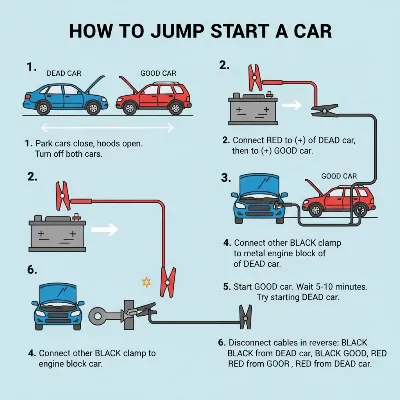 Visual guide for safely jump starting a car with jumper cables and a donor vehicle.
Tips and Tricks When Using a Jump Starter
Beyond the basic steps, a few tips can enhance the effectiveness and safety of using a jump starter, especially in challenging situations.
- Keep Your Jump Starter Charged: A portable jump starter is only useful if it’s charged. Make it a habit to recharge it periodically, especially after use or if it’s been stored for a long time. Check the manufacturer’s recommendations for optimal maintenance.
- Clean Battery Terminals: Corroded battery terminals can impede electrical flow. If you notice white or blue powdery buildup, clean it with a wire brush and a mixture of baking soda and water before connecting the clamps. Ensure terminals are dry before proceeding.
- Allow Time for Charging (Jumper Cables): If using jumper cables with a donor vehicle, let the donor car run for 5-10 minutes with the cables connected before attempting to start the dead car. This allows some charge to transfer to the dead battery, making the start easier.
- Minimize Electrical Load: Before and during the jump start, ensure all non-essential electrical accessories (radio, lights, heater, phone chargers) in the dead vehicle are turned off. This reduces the load on the jump starter or donor battery, directing maximum power to the engine starter.
- Don’t Over-Crank: If the car doesn’t start after a few short attempts (5-10 seconds each), stop and re-evaluate. Continuous cranking can damage the starter motor or overheat the jump starter. There might be a deeper issue than just a dead battery.
- Consider Cold Weather: In extremely cold temperatures, engine oil thickens, and battery performance decreases, requiring more power to start. Opt for a jump starter with a higher CCA rating if you frequently operate in cold climates. Some lithium-ion jump starters are specifically designed for low-temperature performance.
- Roadside Assistance: If you’re unsure about the process, encounter a problem, or suspect more than just a dead battery, it’s always best to call roadside assistance or a professional mechanic. Their expertise can prevent further damage.
Jump Starter – Frequently Asked Questions
Can I jump start a car with a completely dead battery?
Yes, most modern portable jump starters are capable of jump starting a car with a completely dead battery. A “dead” battery simply means it doesn’t have enough charge to crank the engine, not that it’s completely failed. The jump starter provides the necessary power burst to bypass the discharged battery and get the engine running.
How long should I leave a jump starter connected?
You should connect the jump starter for a few minutes before attempting to start the car, especially if the battery is very drained. Once the car starts, disconnect the jump starter within 30-60 seconds, following the reverse order of connection to ensure safety and prevent potential damage to the jump starter or vehicle electronics.
Is it safe to use a jump starter in the rain?
While many modern jump starters have some water resistance, it is generally not recommended to jump start a car in heavy rain or wet conditions. Water can conduct electricity and increase the risk of short circuits or electric shock. If you must jump start in wet weather, ensure the jump starter and connections are as dry as possible, and take extreme caution.
Can a jump starter damage my car’s electronics?
When used correctly, a quality jump starter with safety features (like reverse polarity protection) is unlikely to damage your car’s electronics. However, incorrect usage, such as connecting the clamps improperly or using a faulty unit, can lead to voltage spikes or short circuits that could harm sensitive electronic components. Always follow the instructions carefully.
What’s the difference between Peak Amps and Cold Cranking Amps (CCA)?
Peak Amps refer to the maximum instantaneous current a jump starter can deliver. Cold Cranking Amps (CCA) is a more practical measurement, indicating the sustained current a jump starter can provide for 30 seconds at 0°F (-18°C) while maintaining a minimum voltage. CCA is a better indicator of a jump starter’s true starting power in cold conditions.
Conclusion
The notion of safely jump starting a car without a battery is a dangerous misconception. As we’ve explored, the car battery is an indispensable component of the vehicle’s electrical system, acting not only as the primary power source for starting but also as a critical buffer and voltage stabilizer. Attempting to bypass it can lead to severe and costly damage to sensitive electronics, the alternator, and even pose fire hazards. The key distinction lies between a missing battery and a dead battery: while a dead battery can often be safely revived with a jump start, a vehicle completely lacking a battery cannot.
For reliable roadside assistance, investing in a high-quality portable jump starter is a wise decision. When selecting a jump starter, prioritize sufficient amperage (especially CCA for cold climates), a reliable battery type, and crucial safety features like reverse polarity protection. Adhering to the correct, step-by-step jump-starting procedure is essential to ensure both your safety and the longevity of your vehicle’s electrical system. When faced with a dead battery, smart preparation and safe practices are your best allies. Do you feel confident in your ability to safely jump start your car now?
How to Use a Jump Starter Safely and Effectively
Follow these steps to safely jump start a car with a dead battery using either jumper cables or a portable jump starter, minimizing risk of damage or injury.
Ensure both vehicles (if using jumper cables) are turned off, or that your portable jump starter is adequately charged. Engage the parking brake, put both vehicles in neutral or park, and turn off all electrical accessories in the dead vehicle. Wear safety glasses and gloves for protection.
Connect the red (positive) clamp to the positive (+) terminal of the dead car's battery. If using jumper cables, connect the other red clamp to the donor vehicle's positive terminal, and the black (negative) clamp to the donor vehicle's negative terminal. For the dead car, connect the remaining black (negative) clamp to a clean, unpainted metal part of the engine block or frame, away from the battery. Never connect the negative clamp directly to the dead battery's negative terminal.
If using a donor vehicle, start its engine and let it run for a few minutes. Activate your portable jump starter if applicable. Attempt to start the dead car for no more than 5-10 seconds at a time. If it doesn't start immediately, wait a minute or two before trying again to allow the battery to receive more charge.
Once the dead car starts, let it run for a few minutes. Disconnect the black (negative) clamp from the dead car's engine block or frame first. Then, if using jumper cables, disconnect the black (negative) clamp from the donor vehicle's battery, followed by the red (positive) clamp from the donor vehicle's battery. Finally, disconnect the red (positive) clamp from the now-started car's battery. Always disconnect in the reverse order of connection to minimize spark risk.
Drive the jump-started car for at least 15-30 minutes to allow the alternator to recharge the battery sufficiently. It is highly recommended to have your battery and charging system checked by a professional mechanic as soon as possible to diagnose the underlying reason why the battery died.

I always thought you could just bypass the battery if it was totally dead, but after reading about the electrical network stabilization, it makes so much more sense why you need one in there. I’ve got a portable jump starter now, and it’s been a lifesaver. No more waiting for roadside assistance!
I appreciate the info on why you can’t jump a car without a battery. It’s a good safety reminder. However, I was hoping for more specific recommendations on which portable jump starters are best for different vehicle types. The general advice is helpful, but a little more detail on product features would have been nice.
This really cleared up my confusion about jump starting. I used to think a dead battery meant it was completely out of the circuit, but understanding its role in absorbing voltage fluctuations is key. I’m glad I didn’t try anything risky with my new car’s electronics. My portable power pack has been great for keeping my battery topped up.
My old car had a habit of draining its battery, and I learned the hard way about voltage surges. This explanation about the battery’s buffering action is spot on. I invested in a good quality jump starter with surge protection, and it’s given me so much peace of mind. Definitely worth the investment to protect my car’s sensitive components.