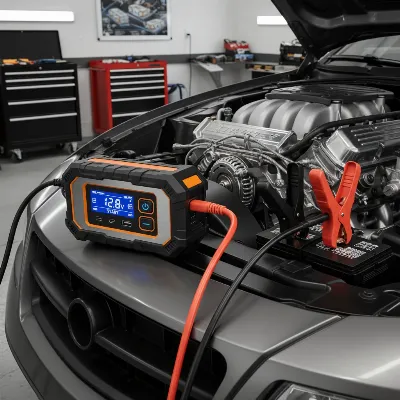
There’s nothing quite like the sudden, disheartening silence when you turn the key, only to realize your car battery has given up. A dead battery can throw a wrench in your plans, whether you’re rushing to work or heading out on a weekend adventure. But what if you could confidently tackle this common problem right from your driveway? Learning how to safely jump start your car, especially with a portable jump starter, is a skill that empowers you to get back on the road quickly and independently.
Jump Starter: An Essential Solution for Vehicle Start-Ups
A jump starter is a portable device designed to provide a temporary surge of electrical power to a discharged car battery, giving your engine the boost it needs to turn over. Unlike traditional jumper cables that rely on a second, working vehicle, a portable jump starter offers true independence, making it an invaluable tool for emergencies, particularly in remote locations where help might not be readily available.
The market offers several types of jump starters, each with distinct advantages. Portable Lithium-Ion Jump Starters are incredibly popular due to their compact size and lightweight design, often no bigger than a smartphone. Despite their small footprint, they pack a powerful punch, capable of delivering multiple jump starts on a single charge. Many models also come equipped with useful extras like USB ports for charging electronic devices and built-in LED flashlights for emergencies. Lead-Acid Jump Starters, on the other hand, are the more traditional, bulkier units. They generally offer higher peak amperage, making them suitable for larger engines like those found in trucks and SUVs. Lastly, Ultracapacitor Jump Starters represent a newer technology, using capacitors instead of chemical batteries. These devices charge in minutes and boast an exceptionally long cycle life, enduring thousands of recharges.
Guide to Choosing the Right Jump Starter
Selecting the perfect jump starter involves understanding your vehicle’s specific needs and the features that matter most for your peace of mind.
Capacity and Starting Current
The power of a jump starter is measured primarily in amps. Peak Amps (PA) refer to the maximum current the unit can deliver in a very short burst, which is the initial jolt needed to crank the engine. More crucial for sustained starting power, especially in colder climates, are Cranking Amps (CA) and Cold Cranking Amps (CCA). These ratings indicate the continuous power the jump starter can provide for 30 seconds at specific temperatures (32°F and 0°F, respectively).
To ensure you choose a jump starter with adequate power, match its amp ratings to your vehicle’s engine size:
- Up to 2.0L Petrol Engines: A jump starter offering 400–600 Peak Amps is typically sufficient.
- 2.0L–3.5L Petrol Engines: Look for units in the 600–1000 Peak Amp range.
- Diesel Engines (up to 3.0L): These often require 1000+ Peak Amps.
- Large Diesel Engines, SUVs, and Trucks: For these heavy-duty vehicles, 1500–2000+ Peak Amps are recommended.
|
Our Picks for the Best Jump Starter in 2026
As an Amazon Associate I earn from qualifying purchases.
|
||
| Num | Product | Action |
|---|---|---|
| 1 | Tire Inflator Portable Air Compressor, 12V Car Jump Starter, 150PSI & 28000mAh Air Pump with Air Blower, Digital Pressure Gauge and LED Light, Electric Air Pump for Car, Motorcycle, Balls, Bike Pump |

|
| 2 | NOCO Boost X GBX55: 1750A UltraSafe Jump Starter – 12V Lithium Battery Booster Pack, Portable Jump Box, Power Bank & Jumper Cables - for 7.5L Gas and 5.0L Diesel Engines |
|
| 3 | KeenPower 6000A Super Capacitor Battery-Less Jump Starter, Built-in 6 * 3000F Supercapacitor, No Traditional Battery |
|
| 4 | Portable Car Jump Starter with Air Compressor for Emergencies,3000A Peak and 150 PSI Max,for 12L Gas & 10L Diesel Engines,LCD Display,LED Light |
|
| 5 | Roar Pedal Super Capacitor Jump Starter, No Need Pre-Charge No Battery 12V Portable Car Jump Starter for All 12V Gas and Diesel Car, Portable Jump Box with Display |
|
| 6 | Tire Inflator Portable Air Compressor with Digitally Display Pressure Gauge 20000mA, Car Air Compressor Pump with Jump Starter 150PSI, 14.8 V Car Battery Jump Starter Portable |
|
| 7 | NOCO Boost X GBX155: 4250A UltraSafe Jump Starter – 12V Lithium Battery Booster Pack, Portable Jump Box, Power Bank & Jumper Cables - for 10.0L Gas and 8.0L Diesel Engines |
|
| 8 | Tire Inflator Portable Air Compressor & Car Jump Starter, Cordless Air Pump with LED Light & Pressure Gauge for Auto,Motorcycles,Bikes,Balls. |
|
| 9 | ANCEL BS200 Super Starter - Permanent Connected Starting System with Super Capacitor, Car Battery Jump Booster & Health Monitor via App, -40℉~176℉ in-Cabin Jump Box for 3.0L Vehicles |
|
| 10 | Jump Starter with Air Compressor, 6000A 150PSI Car Battery Jump Starter (10.0 Gas/8.0L Diesel) Battery Jumper Starter Portable 12V Jump Box with Jumper Cables, LED Light, LED Display |
|
Always consult your vehicle’s owner’s manual for precise recommendations on starting current.
Battery Type
The internal battery chemistry significantly influences a jump starter’s performance and portability.
- Lithium-ion (Li-ion): These batteries are the reason modern jump starters are so compact and lightweight. They offer efficient power delivery, faster charging times, and tend to hold a charge longer when not in use.
- Lead-acid: Found in older, heavier jump starter models, lead-acid batteries are robust and can deliver a high initial jolt, often favored for heavy-duty applications.
Additional Features
Many jump starters offer a suite of supplementary features that enhance their utility beyond just starting your car. A built-in LED flashlight is incredibly useful for nighttime emergencies, while USB ports transform your jump starter into a portable power bank for phones, tablets, and other devices. Crucially, look for advanced safety features such as reverse polarity protection, short-circuit protection, and overcharge safeguards, which prevent damage to both the jump starter and your vehicle’s sensitive electronics. Some high-end models even include an air compressor for inflating tires, and a digital display to monitor the unit’s battery status and output.
Brands and Price
While it might be tempting to opt for the cheapest option, investing in a jump starter from a reputable brand often translates to better reliability, durability, and a more comprehensive set of safety features. Prices can vary widely based on power capacity, battery type, and included functionalities. A higher-quality unit might be a greater initial investment, but its performance and longevity can provide invaluable peace of mind when you need it most.
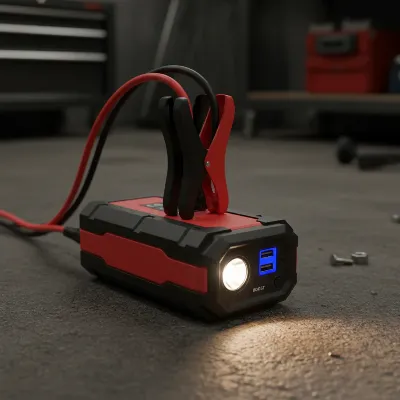 A portable jump starter with its cables and clamps, highlighting key features like USB ports and an LED flashlight.
How to Safely and Effectively Use a Jump Starter
Jump starting your vehicle requires careful attention to detail to ensure both your safety and the integrity of your car’s electrical system.
Before You Start:
- Charge Your Unit: Ensure your portable jump starter is fully charged according to the manufacturer’s instructions. A dead jump starter is just a paperweight.
- Safety First: Don protective eyewear and gloves. Remove any loose clothing, scarves, or jewelry that could get caught in moving engine parts.
- Power Down: Turn off the ignition and all electrical accessories in your vehicle (lights, radio, AC) to prevent power surges.
- Inspect Battery: Visually inspect your car battery. If you notice any signs of physical damage, leaking fluid, or swelling, do not attempt to jump start it. These are indicators of a potentially dangerous internal issue that requires professional attention.
- Park Safely (if using another car): If you are using another vehicle to jump start, park it close enough for the cables to reach comfortably but ensure the vehicles are not touching. Both cars should be in park (automatic) or neutral (manual) with the parking brakes engaged.
Connecting with a Portable Jump Starter (The DIY Method):
- Connect Red Clamp: Attach the red (positive, +) clamp from the jump starter to the positive (+) terminal of your car’s dead battery. Ensure it has a firm, secure connection.
- Connect Black Clamp to Ground: Attach the black (negative, -) clamp from the jump starter to an unpainted metal surface on your engine block or vehicle chassis, away from the battery. This provides a safe ground connection and helps prevent sparks near the battery, which can emit flammable gases.
- Activate Jump Starter: Turn on your portable jump starter, following its specific instructions.
- Start Your Car: Attempt to start your vehicle. Crank the engine for no more than 5 seconds. If it doesn’t start immediately, turn off the ignition.
- Wait and Retry: Wait 2-3 minutes before attempting to start the car again. This allows the jump starter to cool down and the battery to absorb some charge. Avoid more than three short attempts. If the car still doesn’t start, there might be a more significant underlying issue.
Disconnecting the Jump Starter:
- Turn Off Jump Starter: Once your car successfully starts, turn off the portable jump starter.
- Remove Black Clamp: Disconnect the black (negative) clamp from the vehicle’s ground point.
- Remove Red Clamp: Disconnect the red (positive) clamp from the positive (+) terminal of your car battery.
- Keep Running: Let your car engine run for at least 20-30 minutes. This allows your alternator to begin recharging the battery. Consider driving it to a mechanic or an auto parts store for a battery check.
Tips and Tricks for Using a Jump Starter
While jump starting is a relatively straightforward process, a few additional tips can enhance your experience and safety. Always keep your portable jump starter fully charged; a good habit is to top it off every two to three months, especially before long trips or during extreme weather seasons. If your vehicle doesn’t start after a few attempts, remember that every jump starter has a duty cycle. Allowing a cool-down period between attempts prevents overheating and damage to the unit. If your car repeatedly fails to start even with a jump, the problem might not solely be the battery; issues with your alternator or starter motor could be at play, requiring professional diagnosis. Most importantly, always refer to your vehicle’s owner’s manual for any specific jump starting procedures or warnings unique to your car model.
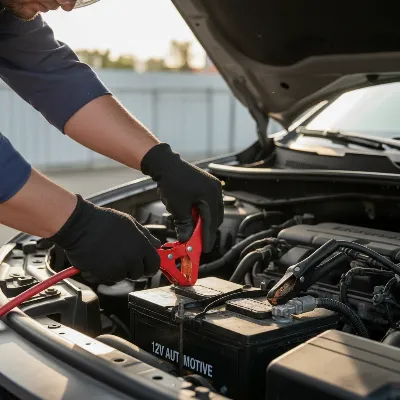 A person safely connecting a portable jump starter to a car battery under the hood, with an emphasis on correct clamp placement and safety gear.
Jump Starter – Frequently Asked Questions
How often should I charge my portable jump starter?
Most manufacturers recommend charging your portable jump starter every two to three months to maintain its optimal performance and ensure it’s ready when you need it. Always check your specific model’s manual for precise recommendations.
Can a jump starter damage my car’s electronics?
Modern portable jump starters are designed with advanced safety features like reverse polarity and short-circuit protection to prevent damage. However, incorrect connections or attempting to jump a severely damaged battery can still pose risks to your vehicle’s electrical system. Always follow the instructions carefully.
What if my car doesn’t start after several attempts?
If your car doesn’t start after two or three attempts, it’s likely that the issue extends beyond a dead battery. It could indicate a problem with your alternator, starter motor, or another component. At this point, it’s best to stop trying and seek professional automotive assistance.
Is it safe to jump start a frozen battery?
While some lithium-ion jump starters can work in cold conditions, it’s generally safer and more effective to jump start a battery that is not completely frozen. Always inspect a frozen battery for any cracks or damage before attempting to jump start it, as a damaged battery can be extremely dangerous. Jump starters perform best at moderate temperatures.
Conclusion
A dead car battery is an inevitable inconvenience for many drivers, but a portable jump starter transforms a potentially frustrating situation into a manageable one. By understanding the types available, selecting the right capacity for your vehicle, and meticulously following safety procedures, you can empower yourself to handle unexpected battery issues with confidence. Having this essential tool and knowledge not only offers immediate relief but also provides a sense of security on every journey. Are you ready to take control of unexpected battery issues on the road?