Facing a dead car battery in freezing winter temperatures is more than just an inconvenience; it can be a dangerous situation. As temperatures plummet, your vehicle’s battery power diminishes, while the engine requires significantly more energy to crank over. This challenging combination often leaves drivers stranded. Fortunately, the right jump starter can provide the reliable power you need to get back on the road swiftly, even in the harshest winter conditions. This comprehensive guide will explore why cold weather impacts your battery, what critical features to look for in a winter-ready jump starter, and our top recommendations for 2026, ensuring you’re prepared for whatever winter throws your way.
Why Cold Weather Challenges Car Batteries and Jump Starters
Winter weather creates a perfect storm for automotive batteries, leading to reduced performance and increased failure rates. The fundamental issue lies in the electrochemical processes that generate power. As temperatures drop, the chemical reactions inside your car’s battery slow down dramatically. This sluggish movement directly translates to a significant reduction in power output and overall diminished capacity, often by as much as 60% below freezing temperatures.
Not only does your car’s battery struggle, but the engine oil also becomes thicker in the cold, increasing resistance and making it harder for the engine to turn over. This combination of a weaker battery and a more resistant engine places immense strain on your starting system. Standard jump starters, including many lithium-ion models, also experience a “performance cliff” in sub-zero conditions. Their internal electrolytes become more viscous, leading to increased internal resistance and a dramatic drop in their advertised peak current output. Without a jump starter specifically engineered for cold, you might find your emergency device struggling just as much as your car battery.
Key Features to Look for in a Winter-Ready Jump Starter
Choosing the right jump starter for cold weather means prioritizing specific features designed to combat the detrimental effects of low temperatures. Not all jump starters are created equal, especially when reliable performance in freezing conditions is paramount.
Amperage and Cold Cranking Amps (CCA)
|
Our Picks for the Best Jump Starter in 2026
As an Amazon Associate I earn from qualifying purchases.
|
||
| Num | Product | Action |
|---|---|---|
| 1 | Tire Inflator Portable Air Compressor with Digitally Display Pressure Gauge 20000mA, Car Air Compressor Pump with Jump Starter 150PSI, 14.8 V Car Battery Jump Starter Portable |

|
| 2 | NOCO Boost X GBX55: 1750A UltraSafe Jump Starter – 12V Lithium Battery Booster Pack, Portable Jump Box, Power Bank & Jumper Cables - for 7.5L Gas and 5.0L Diesel Engines |
|
| 3 | ANCEL BS200 Super Starter - Permanent Connected Starting System with Super Capacitor, Car Battery Jump Booster & Health Monitor via App, -40℉~176℉ in-Cabin Jump Box for 3.0L Vehicles |
|
| 4 | KeenPower 6000A Super Capacitor Battery-Less Jump Starter, Built-in 6 * 3000F Supercapacitor, No Traditional Battery |
|
| 5 | Tire Inflator Portable Air Compressor & Car Jump Starter, Cordless Air Pump with LED Light & Pressure Gauge for Auto,Motorcycles,Bikes,Balls. |
|
| 6 | Portable Car Jump Starter with Air Compressor for Emergencies,3000A Peak and 150 PSI Max,for 12L Gas & 10L Diesel Engines,LCD Display,LED Light |
|
| 7 | Jump Starter with Air Compressor, 6000A 150PSI Car Battery Jump Starter (10.0 Gas/8.0L Diesel) Battery Jumper Starter Portable 12V Jump Box with Jumper Cables, LED Light, LED Display |
|
| 8 | Tire Inflator Portable Air Compressor, 12V Car Jump Starter, 150PSI & 28000mAh Air Pump with Air Blower, Digital Pressure Gauge and LED Light, Electric Air Pump for Car, Motorcycle, Balls, Bike Pump |
|
| 9 | NOCO Boost X GBX155: 4250A UltraSafe Jump Starter – 12V Lithium Battery Booster Pack, Portable Jump Box, Power Bank & Jumper Cables - for 10.0L Gas and 8.0L Diesel Engines |
|
| 10 | Roar Pedal Super Capacitor Jump Starter, No Need Pre-Charge No Battery 12V Portable Car Jump Starter for All 12V Gas and Diesel Car, Portable Jump Box with Display |
|
When selecting a jump starter for winter, the amperage is critical. You’ll often see two main ratings: Peak Amps and Cold Cranking Amps (CCA). Peak Amps represent the maximum current a unit can deliver in a very short burst, which is important for overcoming initial resistance. However, for cold weather, Cold Cranking Amps (CCA) is arguably more vital. CCA measures the battery’s ability to deliver current at 0°F (-18°C) for 30 seconds while maintaining a minimum voltage. A higher CCA rating indicates superior starting power in freezing conditions.
It’s essential to match the jump starter’s power output to your vehicle’s engine size and type. Smaller gasoline engines (up to 4.0L) might do well with 1000-1500 Peak Amps, but larger gas engines, SUVs, and especially diesel vehicles (which require significantly more power to ignite in the cold) will demand 2000 Peak Amps or higher, along with a robust CCA rating. Always check the manufacturer’s recommendations for your specific vehicle.
Battery Technology and Low-Temperature Performance
The type of battery technology within the jump starter profoundly impacts its cold-weather performance. Traditional lead-acid jump starters are bulky and suffer rapid performance deterioration as temperatures fall. While generally more compact and efficient, not all lithium-ion jump starters are created equal for extreme cold. Many consumer-grade lithium cells are not specifically engineered for sub-zero operation.
For optimal winter performance, look for jump starters that explicitly state low-temperature resistance or utilize advanced chemistries like Lithium Iron Phosphate (LiFePO4), which offer better stability in cold. Even more advanced models from brands like GOOLOO and HULKMAN incorporate Pre-Heat Technology. This innovative feature allows the jump starter to detect extremely low temperatures (down to -40°F/-40°C) and automatically warm its internal components for a few minutes before use, ensuring maximum efficiency and starting power when you need it most. This pre-heating capability can make the difference between a successful start and being stranded.
Capacity (mAh) and Multi-Functionality
Beyond raw starting power, a jump starter’s capacity, typically measured in milliampere-hours (mAh), determines how much stored energy it holds. A higher capacity is beneficial for several reasons: it allows for multiple jump-start attempts on a single charge and extends the unit’s ability to serve as a portable power bank. In winter emergencies, having extra power to charge your phone, tablet, or other essential devices can be a lifesaver.
Many modern jump starters are designed as versatile emergency tools. Look for integrated features such as:
- LED Flashlight: Essential for nighttime repairs or signaling, often with multiple modes like steady beam, strobe, and SOS.
- USB Charging Ports: Including USB-A and USB-C ports for charging personal electronics.
- Built-in Air Compressor: Some premium models offer an integrated air compressor, useful for reinflating flat tires, which can also lose pressure in cold weather.
These additional features enhance the utility of your jump starter, making it a valuable companion for any roadside emergency, not just a dead battery.
Robustness and Safety Protections
A jump starter that will be stored in your vehicle, especially through harsh winters, needs to be built to last. Look for models with a rugged, durable construction that can withstand drops, bumps, and the rigors of vehicle storage. Weatherproofing with an IP (Ingress Protection) rating, such as IP65, indicates resistance to dust and water splashes, crucial for outdoor use in snowy or wet conditions.
Perhaps most importantly, a reliable jump starter must incorporate comprehensive safety features to protect both the user and the vehicle’s electrical system. These essential safeguards include:
- Reverse-Polarity Protection: Prevents damage if the clamps are connected incorrectly.
- Short-Circuit Protection: Shuts off power if a short circuit is detected.
- Over-Charge Protection: Prevents damage from overcharging the internal battery.
- Over-Heat Protection: Monitors temperature to prevent overheating during operation.
- Low Voltage Protection: Protects the jump starter’s internal battery from draining too low.
- Spark-Proof Clamps: Designed to prevent accidental sparks during connection.
These features ensure a safe and user-friendly experience, even for those unfamiliar with jump-starting a vehicle.
Top Jump Starter Recommendations for Winter 2026
Choosing the best jump starter for cold weather in 2026 involves balancing power, specialized winter features, and overall reliability. Based on current trends and innovations, here are some top recommendations that excel in challenging conditions:
| Model/Brand | Peak Amps (12V) | Key Winter Features | Engine Compatibility (Gas/Diesel) | Battery Type | Additional Features | Price Range |
|---|---|---|---|---|---|---|
| CARKU JS396 | 7000A (12/24V) | LiFePO4, high capacity, rugged | Very large gas/diesel | Lithium Iron Phos. | USB charging, heavy-duty clamps, long cycle life | Premium |
| NOCO Boost X GBX155 | 4250A | Robust build, advanced safeguards | Up to 10.0L Gas / 8.0L Diesel | Lithium-Ion | USB-A/C, LED flashlight | Premium |
| Battery Tender 2000 AMP | 2000A | Solid build, reliable clamps | Most cars/SUVs | Lithium-Ion | Smart protection tech, compact | Mid-Range |
| GOOLOO GT4000 | 4000A | Pre-Heat -40°F Start Tech, low-temp resistance | Up to 10.0L Gas / 8.0L Diesel | Lithium-Ion | USB-A/C, LED flashlight, digital display | Mid-Range |
| HULKMAN Alpha 85S/100 | 4000A/6000A | Pre-Heat -40°F Function, low-temp resistance | Up to 8.5L/10.0L Gas, 6.0L/8.0L Diesel | Lithium-Ion | LCD screen, fast charging, USB-A/C | Mid-Premium |
| Avapow 6000A | 6000A | Brute force, compact | Up to 8.0L Gas / Many Diesels | Lithium-Ion | USB charging, LED flashlight, safety features | Mid-Range |
| NOCO Boost+Air AX65 | 2000A | Integrated 100 PSI air compressor | Most gas engines / smaller diesels | Lithium-Ion | USB charging, LED work light, pressure presets | Premium |
> “In deep winter, a jump starter isn’t just a convenience; it’s a safety device. Prioritize models with high CCA and specialized cold-weather features like pre-heating capabilities to ensure reliability when temperatures plummet.” – David Chen, Automotive Technician specializing in battery systems.
CARKU’s JS396 stands out for its exceptional power and robust LiFePO4 technology, making it suitable for even the largest vehicles and professional use in extreme conditions. For those seeking top-tier power and comprehensive safety, the NOCO Boost X GBX155 is a consistent performer. However, for dedicated cold-weather starting, models like the GOOLOO GT4000 and HULKMAN Alpha 85S/100, with their innovative pre-heat functions, offer a distinct advantage, ensuring performance down to extreme sub-zero temperatures. The NOCO Boost+Air AX65 is an excellent choice for versatility, combining jump-starting with tire inflation, which is invaluable in winter.
How to Safely and Effectively Use a Jump Starter in Winter
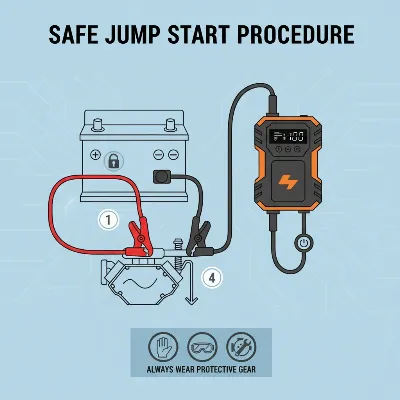
Using a jump starter correctly is crucial for both safety and effectiveness, especially in cold weather. Always refer to your specific device’s manual, but here are general steps and safety tips:
- Preparation: Ensure your jump starter is fully charged. In very cold conditions, if your jump starter has a pre-heat function, activate it a few minutes before connecting. If not, try to warm the unit slightly (e.g., in a warm interior for a few minutes) if it has been stored in extreme cold.
- Safety First: Wear gloves and eye protection. Make sure both vehicles (if applicable) are turned off with parking brakes engaged.
- Connect Clamps:
- Attach the red (positive) clamp to the positive (+) terminal of the dead battery.
- Attach the black (negative) clamp to a clean, unpainted metal surface on the engine block or vehicle chassis, away from the battery. Avoid connecting directly to the negative terminal of the dead battery unless specified by the manufacturer.
- Many modern jump starters have smart clamps that will alert you to incorrect connections.
- Initiate Jump Start: Turn on the jump starter. If your unit has a “boost” button or specific mode for completely dead batteries, activate it.
- Start the Vehicle: Attempt to start your vehicle. If it doesn’t start immediately, wait a minute or two and try again. Avoid cranking for more than 5-7 seconds at a time to prevent overheating.
- Disconnect: Once the vehicle starts, remove the black (negative) clamp first, then the red (positive) clamp. Allow your vehicle to run for at least 15-20 minutes to recharge its battery.
Safety Precautions:
- Read the Manual: Always familiarize yourself with your specific jump starter’s instructions.
- Avoid Short Circuits: Ensure clamps do not touch each other or other metal parts after connection.
- Proper Ventilation: Use in a well-ventilated area, as batteries can release explosive gases.
- Never Jump a Damaged Battery: Do not attempt to jump-start a cracked or leaking battery.
Maintaining Your Jump Starter for Winter Reliability
Even the best jump starter requires proper care to ensure it performs reliably when you need it most. Consistent maintenance will prolong its lifespan and guarantee readiness, especially during the winter months.
Ideally, store your jump starter in a location with temperatures between 50°F and 70°F (10°C and 21°C) for maximum performance. While most modern lithium-ion jump starters can be safely stored in your car during winter, be aware that extreme cold can still reduce their efficiency over time. If your jump starter has been stored in freezing temperatures, it’s advisable to bring it indoors for a few hours to allow it to warm up naturally before use, unless it features specific pre-heat technology.
Regular charging is paramount. It is recommended to recharge your jump starter every three months to keep its internal battery above 80% capacity. This habit not only preserves the battery’s lifespan but also ensures it’s ready for immediate use in an emergency. Crucially, if you’ve used your jump starter in very cold conditions, do not immediately plug it into a charger. Allow the device to reach room temperature naturally over several hours before charging. Charging a frozen or extremely cold lithium-ion cell can accelerate degradation and potentially cause damage. Additionally, before winter sets in, perform a simple check to ensure all cables and clamps are in good condition.
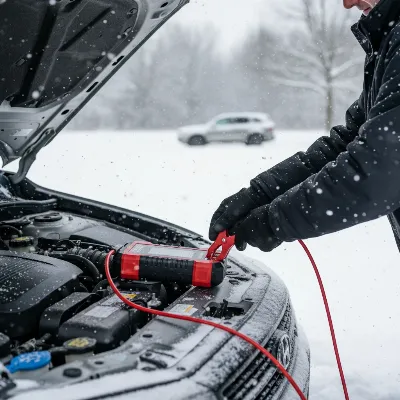 A person connecting a portable jump starter to a car battery in a snowy, cold winter environment.
Jump Starters for Cold Weather: Frequently Asked Questions
How cold is too cold for a jump starter?
Most standard jump starters experience significant performance degradation below freezing (32°F/0°C). However, premium models with specialized low-temperature resistant batteries or pre-heat technology can operate effectively down to -20°F (-29°C) or even -40°F (-40°C), maintaining critical power output.
Can I leave my jump starter in the car during winter?
Yes, most modern lithium-ion jump starters are safe to leave in your car during winter. While optimal performance is achieved at room temperature, their advanced battery chemistry allows them to withstand cold storage. Just remember to check its charge regularly and consider warming it up before use in extreme cold.
What’s the difference between Peak Amps and CCA for cold weather?
Peak Amps refer to the maximum current delivered in a short burst, indicating raw power. Cold Cranking Amps (CCA), however, specifically measures how much current a battery can supply at 0°F (-18°C) for 30 seconds while maintaining a minimum voltage. For cold weather, a higher CCA rating is a more reliable indicator of starting performance.
How often should I charge my jump starter if it’s stored in the cold?
It is generally recommended to recharge your jump starter every three months, keeping its charge level above 80%, regardless of storage conditions. This practice helps maintain battery health and ensures it’s ready for immediate use, especially during the unpredictable winter months.
Are lithium jump starters safe to use in sub-zero temperatures?
Yes, high-quality lithium jump starters with appropriate safety features are safe to use in sub-zero temperatures. However, their power output may be reduced unless they are specifically designed with low-temperature resistant batteries or pre-heat functions to mitigate the effects of extreme cold on internal chemistry.
Conclusion
A reliable jump starter is an indispensable tool for any driver, particularly during the unforgiving cold of winter. Understanding how freezing temperatures impact battery performance and knowing what features to prioritize—such as high CCA ratings, low-temperature resistant battery technology, and crucial safety protections—will empower you to make an informed choice. Investing in a top-tier jump starter like the CARKU JS396, a NOCO Boost series model, or a pre-heat equipped GOOLOO GT4000 or HULKMAN Alpha can provide peace of mind and prevent roadside dilemmas. By choosing the right device and maintaining it properly, you can confidently navigate the winter months, knowing you have the power to overcome a dead battery. What feature do you consider most essential in a winter jump starter for your vehicle?