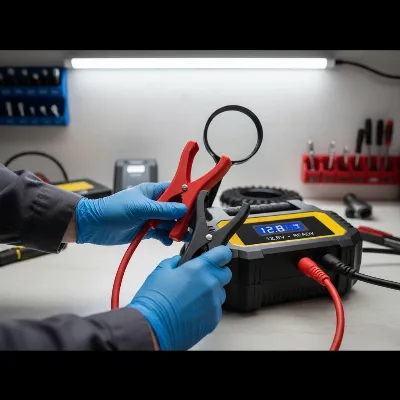
A portable jump starter is a modern marvel, offering the peace of mind of reviving a dead car battery without relying on another vehicle or waiting for roadside assistance. It’s an indispensable tool for any driver, turning a potentially frustrating roadside emergency into a minor inconvenience. However, like any battery-powered device, its readiness and longevity hinge on proper maintenance, particularly consistent charging. Forgetting to charge your jump starter can leave you stranded, rendering this crucial device useless precisely when you need it most. Understanding the optimal charging frequency isn’t just about convenience; it’s about ensuring your jump starter remains a reliable lifeline for years to come.
Jump Starter: An Essential Roadside Companion
Portable jump starters are compact, handheld devices designed to deliver a powerful surge of electricity to a drained vehicle battery, allowing the engine to start. Unlike traditional jumper cables that require a second, running vehicle, a portable jump starter is a self-contained power source. They typically feature an internal battery, heavy-duty cables with alligator clamps, and often come equipped with additional functionalities such as LED flashlights, USB charging ports for mobile devices, and even air compressors.
The market primarily offers two types of portable jump starters: lead-acid and lithium-ion. Lead-acid models are generally larger and heavier, resembling miniature car batteries, and have been around longer. Lithium-ion jump starters, on the other hand, are significantly more compact, lighter, and often boast higher power output for their size. Both types serve the same fundamental purpose, but their internal chemistry can sometimes influence maintenance nuances, particularly concerning temperature sensitivity and overall lifespan. Regardless of the type, a well-maintained jump starter is an invaluable asset in any emergency kit, providing quick power to get vehicles moving again.
Understanding Optimal Charging Frequency
Ensuring your portable jump starter is ready for action whenever a dead battery strikes is paramount. The key to this readiness lies in understanding and adhering to a consistent charging schedule. While the exact frequency can vary slightly between models and battery types, several general guidelines apply to maximize your jump starter’s efficiency and lifespan.
The Golden Rule: Regular Maintenance Charging
|
Our Picks for the Best Jump Starter in 2026
As an Amazon Associate I earn from qualifying purchases.
|
||
| Num | Product | Action |
|---|---|---|
| 1 | Tire Inflator Portable Air Compressor & Car Jump Starter, Cordless Air Pump with LED Light & Pressure Gauge for Auto,Motorcycles,Bikes,Balls. |

|
| 2 | Jump Starter with Air Compressor, 6000A 150PSI Car Battery Jump Starter (10.0 Gas/8.0L Diesel) Battery Jumper Starter Portable 12V Jump Box with Jumper Cables, LED Light, LED Display |
|
| 3 | Tire Inflator Portable Air Compressor with Digitally Display Pressure Gauge 20000mA, Car Air Compressor Pump with Jump Starter 150PSI, 14.8 V Car Battery Jump Starter Portable |
|
| 4 | NOCO Boost X GBX55: 1750A UltraSafe Jump Starter – 12V Lithium Battery Booster Pack, Portable Jump Box, Power Bank & Jumper Cables - for 7.5L Gas and 5.0L Diesel Engines |
|
| 5 | Portable Car Jump Starter with Air Compressor for Emergencies,3000A Peak and 150 PSI Max,for 12L Gas & 10L Diesel Engines,LCD Display,LED Light |
|
| 6 | Tire Inflator Portable Air Compressor, 12V Car Jump Starter, 150PSI & 28000mAh Air Pump with Air Blower, Digital Pressure Gauge and LED Light, Electric Air Pump for Car, Motorcycle, Balls, Bike Pump |
|
| 7 | ANCEL BS200 Super Starter - Permanent Connected Starting System with Super Capacitor, Car Battery Jump Booster & Health Monitor via App, -40℉~176℉ in-Cabin Jump Box for 3.0L Vehicles |
|
| 8 | NOCO Boost X GBX155: 4250A UltraSafe Jump Starter – 12V Lithium Battery Booster Pack, Portable Jump Box, Power Bank & Jumper Cables - for 10.0L Gas and 8.0L Diesel Engines |
|
| 9 | KeenPower 6000A Super Capacitor Battery-Less Jump Starter, Built-in 6 * 3000F Supercapacitor, No Traditional Battery |
|
| 10 | Roar Pedal Super Capacitor Jump Starter, No Need Pre-Charge No Battery 12V Portable Car Jump Starter for All 12V Gas and Diesel Car, Portable Jump Box with Display |
|
The most crucial aspect of jump starter maintenance is performing regular “maintenance charges,” even if you haven’t used the device. Most manufacturers and experts recommend charging your portable jump starter at least every three to six months. Some specific models or battery types might even suggest a more frequent schedule, such as every 90 days or every two to three months. This practice prevents the battery from falling into a state of deep discharge, which can significantly reduce its overall lifespan and capacity. Regular topping up ensures the internal battery cells remain healthy and primed to deliver maximum power when called upon.
Always refer to your specific device’s user manual for the manufacturer’s exact recommendations. These guidelines are tailored to the battery chemistry and design of your particular jump starter and will provide the most accurate advice for optimal care. Following these instructions is the best way to safeguard your investment and ensure it performs reliably for years.
Recharge After Every Use
Beyond routine maintenance, it is absolutely essential to recharge your portable jump starter as soon as possible after each use. Even if the device indicates it has remaining power for multiple jumps, fully recharging it immediately ensures maximum readiness for the next emergency. Prompt recharging also helps prevent the battery from sitting in a partially discharged state, which can put unnecessary stress on the cells and contribute to premature degradation. Think of it like refueling your car after a trip; you wouldn’t want to start your next journey on an empty tank, and the same principle applies to your jump starter.
Impact of Storage Conditions
Where and how you store your portable jump starter plays a significant role in how well its battery holds a charge. Extreme temperatures, both hot and cold, can severely impact battery health and accelerate self-discharge. Storing a jump starter in a very hot car during summer, for instance, can degrade the battery cells more quickly, while freezing temperatures can temporarily reduce its performance and overall capacity.
For optimal longevity, store your jump starter in a cool, dry place. An ideal temperature range is typically between 50 and 70 degrees Fahrenheit (10-20 degrees Celsius). This moderate environment helps preserve the battery’s charge and chemical integrity. If your storage conditions are less than ideal, such as in a garage that experiences wide temperature swings, you might consider increasing the frequency of your maintenance charges to compensate for potential accelerated discharge.
Monitoring Battery Levels
Most modern portable jump starters come equipped with clear indicators to help you monitor their charge status. These can range from simple LED indicator lights that change color or show bars representing charge levels, to more advanced digital LCD screens that display a precise percentage. Regularly checking these indicators is a straightforward way to gauge your device’s readiness.
It’s generally recommended to keep your jump starter’s battery level above 80% for emergency preparedness. Some experts even suggest storing lithium-ion batteries at around 70-80% capacity for optimal long-term health, as constant full charging can, in some cases, put a slight strain on the battery. However, for practical emergency readiness, ensuring it’s topped up to near full is usually the safest bet. If the indicators show a low charge, it’s a clear signal that it’s time for a recharge.
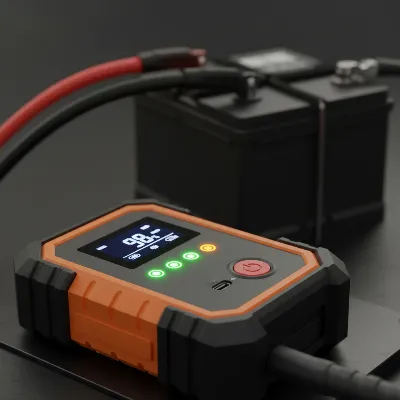 Portable jump starter with LED indicators displaying battery charge level for vehicle owners
Factors Influencing Charging Habits
While the general guidelines provide a solid framework, specific factors related to your jump starter’s technology and your usage patterns can subtly influence the best charging habits. Understanding these nuances can help you fine-tune your maintenance routine for maximum effectiveness and longevity.
Battery Chemistry
The type of battery inside your jump starter significantly affects its charging characteristics and overall lifespan.
- Lithium-ion (Li-ion): These are prevalent in newer, more compact jump starters. Li-ion batteries benefit from partial charging and do not suffer from the “memory effect,” meaning you don’t need to fully discharge them before recharging. They also have a longer cycle life (300-500 charge cycles, some up to 1000 or more) and can hold a charge for 3-6 months or even longer due to low self-discharge rates. Advanced LiFePO4 (Lithium Iron Phosphate) types can last even longer, potentially up to 10 years under proper conditions.
- Lead-acid: Found in older or larger, heavier units, lead-acid batteries are more susceptible to damage from deep discharges. While modern versions have improved, they generally prefer to be kept fully charged and may require more frequent topping up than lithium counterparts, sometimes even monthly for older models, to prevent sulfation.
Usage Frequency
The more you use your jump starter, the more frequently it will need charging. If you find yourself jump-starting vehicles often, perhaps for multiple vehicles or in a professional capacity, immediate recharging after each use becomes even more critical. For those who rarely use their jump starter, relying on the 3-6 month maintenance charge schedule is appropriate. However, it’s easy to forget about a tool you don’t use often, so setting a recurring calendar reminder is a smart strategy to ensure it’s always ready.
Age of the Jump Starter
Like all batteries, those in jump starters degrade over time, regardless of how meticulously they are maintained. An older jump starter, typically beyond 2-3 years for many lithium-ion models, may not hold a charge for as long or deliver the same peak power as it did when new. As a battery ages, its internal resistance increases, and its capacity to store energy diminishes. You might notice that an older unit requires more frequent charging, even when stored properly, or that its charge indicator drops more quickly. If your jump starter is several years old and struggles to hold a charge, it might be time to consider a replacement to ensure reliable performance.
Best Practices for Jump Starter Longevity
Extending the life of your portable jump starter goes beyond just charging; it involves a holistic approach to care and usage. Adopting a few best practices can significantly enhance its performance and ensure it remains a dependable tool when emergencies arise.
Avoid Deep Discharges
The single most destructive factor for any battery, whether lithium-ion or lead-acid, is allowing it to sit in a deeply discharged state for an extended period. A battery that is completely drained can suffer irreversible damage, reducing its capacity and potentially rendering it unable to accept a charge altogether. This is why immediate recharging after use and regular maintenance charges during storage are so vital. Always aim to keep the battery above a minimal charge level, ideally above 50%, and preferably above 80% for readiness.
Use the Correct Charger
Always use the charger provided by the manufacturer with your jump starter, or a certified replacement with the correct specifications. Using an incompatible charger can lead to inefficient charging, battery damage, or even safety hazards. While some jump starters have USB ports for charging, these are often slower and may not provide the optimal power input compared to the dedicated wall adapter. The dedicated charger is designed to deliver the correct voltage and amperage, ensuring efficient and safe charging without overstressing the battery.
General Maintenance Tips
Beyond charging, a few simple maintenance habits can prolong your jump starter’s life:
- Inspect Regularly: Periodically check the cables and clamps for any signs of damage, fraying, or corrosion. Damaged cables can be a safety hazard and reduce effectiveness.
- Cleanliness: Keep the unit clean, especially around the connectors. Dust and debris can sometimes interfere with proper function.
- Storage Environment: Reiterate the importance of a cool, dry place. Avoid storing it in direct sunlight or in areas prone to extreme humidity.
- Avoid Constant Plugin: While many modern jump starters have overcharge protection, some manufacturers still advise against leaving the unit plugged in constantly. While it keeps the unit ready, continuously topping off the battery can, over a very long term, contribute to minute degradation cycles. Check your specific manual for advice on this.
> “A portable jump starter is a fantastic tool, but it’s only as good as its charge. Consistent, mindful charging habits are the most impactful thing you can do to ensure it’s there for you in a pinch.” – Dr. Eleanor Vance, Automotive Battery Specialist
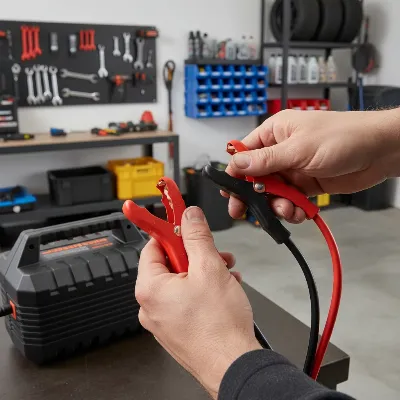 Person inspecting and maintaining a portable jump starter with care in a garage setting
Jump Starter – Frequently Asked Questions
How long does a portable jump starter hold its charge?
Most modern lithium-ion portable jump starters can hold a significant charge for 3 to 6 months, and some advanced models even longer, up to 18 months, due to low self-discharge rates. However, it’s generally recommended to perform a maintenance charge every 3 months to ensure optimal battery health and readiness.
Can I leave my jump starter plugged in all the time?
Many modern jump starters feature advanced overcharge protection, making it safe to leave them plugged in. This ensures they are always at 100% capacity and ready for immediate use. However, some experts suggest unplugging them once fully charged and recharging every few months to slightly prolong the battery’s overall lifespan, though the difference might be negligible for typical users. Always check your manufacturer’s specific recommendations.
What happens if I don’t charge my jump starter regularly?
If you don’t charge your jump starter regularly, its internal battery will slowly self-discharge over time. Allowing it to remain in a deeply discharged state can cause irreversible damage to the battery cells, significantly reduce its overall capacity and lifespan, and eventually render it unable to hold a charge or jump-start a vehicle when needed.
Is it okay to partially charge a jump starter?
Yes, it is perfectly fine to partially charge most modern portable jump starters, especially those with lithium-ion batteries. Lithium-ion batteries do not suffer from the “memory effect,” meaning that short, frequent charges will not harm them or reduce their capacity. In fact, keeping them topped up and avoiding deep discharges is beneficial for their longevity.
Conclusion
A portable jump starter is an invaluable asset for any vehicle owner, providing crucial independence in the face of a dead battery. However, the true value of this device lies in its readiness, which is directly tied to consistent and proper charging. By embracing a routine of recharging your jump starter every three to six months, and crucially, immediately after each use, you ensure it remains primed for action. Understanding the impact of storage conditions, monitoring battery indicators, and adhering to manufacturer guidelines further extends its lifespan and reliability. Don’t let a dead jump starter be the reason you’re stranded; proactive charging habits are the key to unlocking its full potential and ensuring peace of mind on every journey. When was the last time you checked your jump starter’s charge?