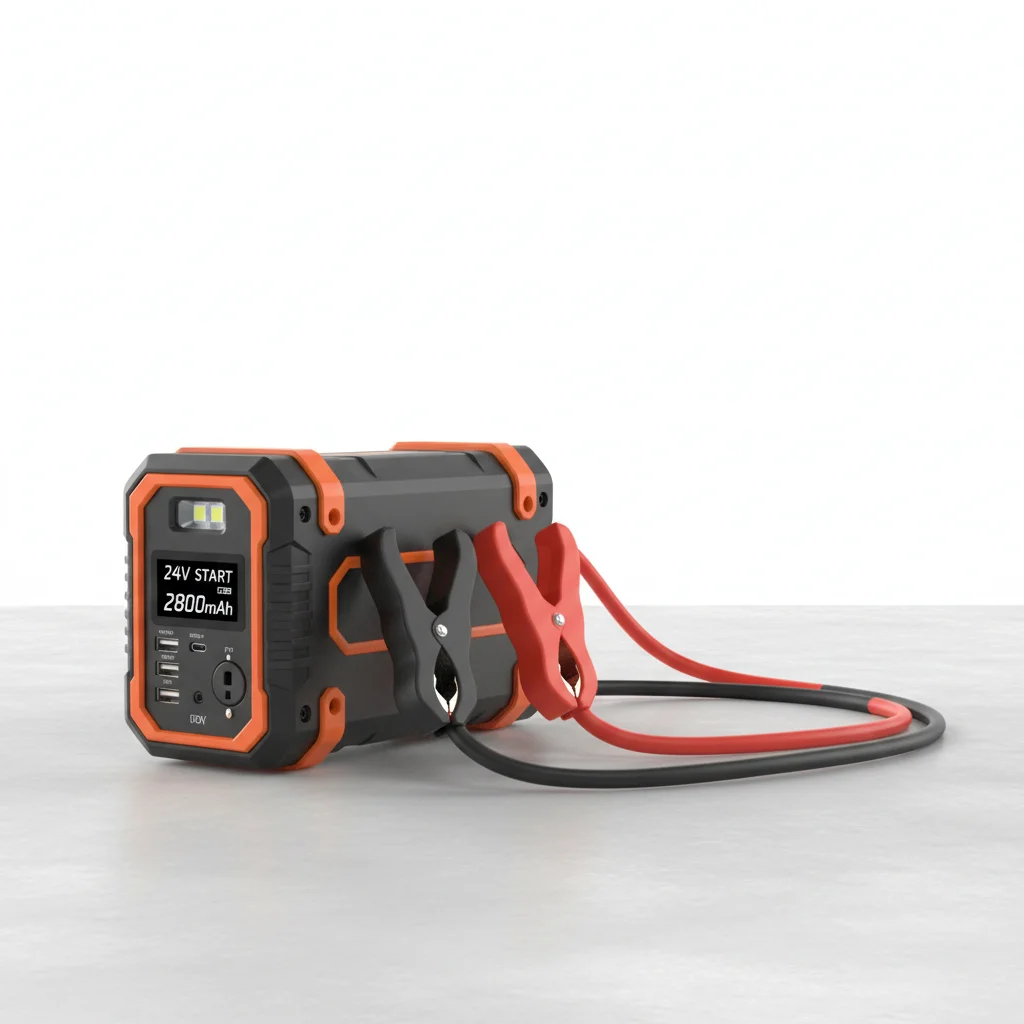
When selecting a jump starter for a diesel truck, you typically need a 12-volt unit, though some heavy-duty applications may require 24 volts. The critical factor isn’t just the voltage, but also the peak amperage and battery capacity, as diesel engines demand significantly more power to crank compared to gasoline engines. A robust jump starter with at least 2000 peak amps and a substantial battery capacity is often recommended for most consumer-grade diesel trucks, while commercial or larger diesel vehicles might necessitate even higher specifications.
Understanding Diesel Truck Electrical Systems
Most light-duty and medium-duty diesel trucks, such as those from Ford, Ram, and Chevrolet, operate on a 12-volt electrical system, identical to their gasoline counterparts. However, the batteries themselves are often larger and designed to deliver higher cold cranking amps (CCA) to overcome the higher compression ratios of diesel engines. Heavy-duty commercial trucks, semi-trucks, and some industrial diesel equipment frequently utilize a 24-volt system, often achieved by connecting two 12-volt batteries in series. It’s crucial to verify your truck’s specific voltage requirement before purchasing a jump starter to prevent damage to either the vehicle or the jump starter.
Peak Amperage: The Real Power Metric
While voltage is important for compatibility, peak amperage is the true indicator of a jump starter’s ability to crank a stubborn diesel engine. Diesel engines require a massive surge of current to turn over, especially in cold weather. For most consumer diesel pickups (e.g., Ford F-250/350, Ram 2500/3500, Chevy Silverado/GMC Sierra 2500/3500), a jump starter with 2000 to 3000 peak amps is generally sufficient. Larger diesel engines, or those in extremely cold conditions, might benefit from units offering 4000 peak amps or more. Always check the CCA rating of your truck’s battery and aim for a jump starter that can meet or exceed that demand.
Battery Capacity and Engine Size Considerations
|
Our Picks for the Best Jump Starter in 2026
As an Amazon Associate I earn from qualifying purchases.
|
||
| Num | Product | Action |
|---|---|---|
| 1 | NOCO Boost X GBX155: 4250A UltraSafe Jump Starter – 12V Lithium Battery Booster Pack, Portable Jump Box, Power Bank & Jumper Cables - for 10.0L Gas and 8.0L Diesel Engines |

|
| 2 | Tire Inflator Portable Air Compressor & Car Jump Starter, Cordless Air Pump with LED Light & Pressure Gauge for Auto,Motorcycles,Bikes,Balls. |
|
| 3 | ANCEL BS200 Super Starter - Permanent Connected Starting System with Super Capacitor, Car Battery Jump Booster & Health Monitor via App, -40℉~176℉ in-Cabin Jump Box for 3.0L Vehicles |
|
| 4 | NOCO Boost X GBX55: 1750A UltraSafe Jump Starter – 12V Lithium Battery Booster Pack, Portable Jump Box, Power Bank & Jumper Cables - for 7.5L Gas and 5.0L Diesel Engines |
|
| 5 | KeenPower 6000A Super Capacitor Battery-Less Jump Starter, Built-in 6 * 3000F Supercapacitor, No Traditional Battery |
|
| 6 | Tire Inflator Portable Air Compressor, 12V Car Jump Starter, 150PSI & 28000mAh Air Pump with Air Blower, Digital Pressure Gauge and LED Light, Electric Air Pump for Car, Motorcycle, Balls, Bike Pump |
|
| 7 | Jump Starter with Air Compressor, 6000A 150PSI Car Battery Jump Starter (10.0 Gas/8.0L Diesel) Battery Jumper Starter Portable 12V Jump Box with Jumper Cables, LED Light, LED Display |
|
| 8 | Portable Car Jump Starter with Air Compressor for Emergencies,3000A Peak and 150 PSI Max,for 12L Gas & 10L Diesel Engines,LCD Display,LED Light |
|
| 9 | Roar Pedal Super Capacitor Jump Starter, No Need Pre-Charge No Battery 12V Portable Car Jump Starter for All 12V Gas and Diesel Car, Portable Jump Box with Display |
|
| 10 | Tire Inflator Portable Air Compressor with Digitally Display Pressure Gauge 20000mA, Car Air Compressor Pump with Jump Starter 150PSI, 14.8 V Car Battery Jump Starter Portable |
|
Beyond peak amps, the internal battery capacity of the jump starter (often measured in milliamp-hours or watt-hours) dictates how many attempts you can make and how long the unit can sustain its output. A higher capacity means more reserve power, which is vital for diesel engines that may take longer to start. For a typical V8 diesel truck, look for a jump starter with at least 60 Wh of battery capacity. For larger engines or multiple jump starts, capacities exceeding 80 Wh are preferable. Consider the engine displacement (e.g., 6.7L Power Stroke, 6.6L Duramax, 6.7L Cummins) as a guide; larger engines generally demand more powerful jump starters.
- Verify your truck’s voltage (12V or 24V) before purchase.
- Aim for 2000-3000 peak amps for most consumer diesel trucks.
- Consider 4000+ peak amps for larger or commercial diesel engines.
- Look for battery capacities of 60 Wh or more for reliable performance.
- Ensure the jump starter has robust clamps and heavy-gauge cables.
Features to Look for in a Diesel Jump Starter
When selecting a jump starter for a diesel truck, several features enhance usability and safety. Reverse polarity protection is essential to prevent damage if the clamps are connected incorrectly. Spark-proof technology adds another layer of safety. Many modern jump starters also include USB ports for charging devices, and some even integrate air compressors, which can be incredibly useful for maintaining tire pressure or reinflating a flat. Durability and a rugged casing are also important, given the demanding environments where diesel trucks often operate.
Maintaining Your Diesel Jump Starter
Proper maintenance ensures your jump starter is ready when you need it most. Always store the unit in a cool, dry place and recharge it regularly, typically every 3-6 months, even if it hasn’t been used. Avoid fully discharging the unit, as this can reduce its overall lifespan. Keep the clamps clean and free of corrosion. For units with internal lead-acid batteries, ensure proper ventilation during charging. Following the manufacturer’s guidelines for charging and storage will maximize the longevity and reliability of your investment.

Great info on the voltage requirements. I always thought all jump starters were the same, but the explanation about diesel engines needing more power to crank made a lot of sense. My 12-volt unit with 2000 peak amps has been reliable for my Ram 3500. It’s a solid piece of mind to have on hand.
I finally got tired of my old jump starter not being able to crank my F-250. This guide really helped me understand why my old one was failing. I ended up getting a 2500 peak amp unit, and it starts my truck like a champ every single time, even in cold weather. Definitely worth investing in a powerful one for diesel engines.
This was super helpful for understanding the difference between gasoline and diesel jump starter needs. I drive a Ford diesel and was always worried about getting stranded. Knowing to look for a unit with a substantial battery capacity, not just high amps, was key. My new one has saved me a couple of times already.
The advice on peak amperage was spot on for my Chevy Silverado diesel. However, I wish there was a bit more detail on specific brands that offer good 24-volt options for really heavy-duty applications. The one I got works, but it feels a little underpowered for what I need sometimes. Still, good general guidance.