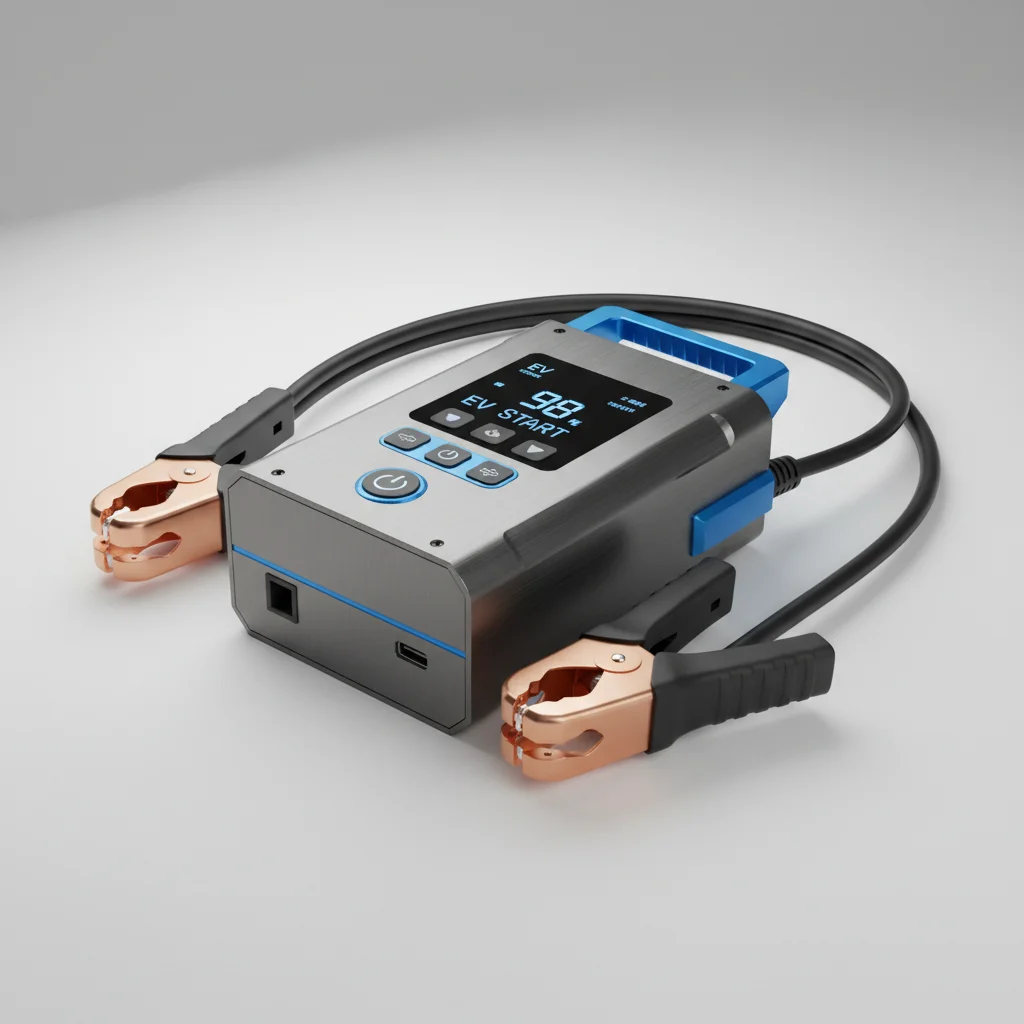
Electric cars, while not having a traditional starter motor, still rely on a 12V auxiliary battery for critical functions like unlocking doors, powering infotainment, and initiating the high-voltage system. If this 12V battery dies, your EV will be completely immobilized. For most electric cars, a jump starter with a peak amperage of 400-800A is sufficient to revive the 12V auxiliary battery. This range provides enough power to engage the contactors and allow the main traction battery to recharge the 12V system, getting you back on the road.
Understanding the EV 12V Battery System
Unlike gasoline vehicles where the 12V battery cranks the engine, in an EV, its primary role is to power the vehicle’s low-voltage electronics and act as a ‘bootstrapping’ mechanism for the high-voltage system. When this battery is depleted, the car cannot communicate with its various modules, making it appear completely dead. The high-voltage battery then recharges the 12V system once the car is ‘on’.
The 12V battery in an EV is typically much smaller than in an internal combustion engine (ICE) vehicle, often resembling a motorcycle battery. Its capacity is designed for short bursts of power to initiate systems, not for sustained cranking. Therefore, the jump starter requirements are different; you’re not trying to turn over a massive engine, but rather to provide enough current to wake up the car’s internal computers.
Choosing the Right Amperage for Your EV
For most passenger electric vehicles, a jump starter offering between 400 and 800 peak amps is generally adequate. This range provides a safe and effective boost for the smaller 12V auxiliary batteries found in EVs. Overpowering the 12V system is rarely a concern with modern jump starters, as the car’s internal electronics will only draw the current they need. However, using an excessively powerful unit is unnecessary and can be a waste of money.
It’s always wise to consult your vehicle’s owner’s manual for specific recommendations regarding jump-starting procedures and any particular amperage requirements for your model. Some luxury EVs or those with more complex 12V systems might benefit from the higher end of this range, but for the majority, a mid-range portable jump starter will suffice.
Key Features to Look for in an EV Jump Starter
|
Our Picks for the Best Jump Starter in 2026
As an Amazon Associate I earn from qualifying purchases.
|
||
| Num | Product | Action |
|---|---|---|
| 1 | NOCO Boost X GBX55: 1750A UltraSafe Jump Starter – 12V Lithium Battery Booster Pack, Portable Jump Box, Power Bank & Jumper Cables - for 7.5L Gas and 5.0L Diesel Engines |

|
| 2 | Roar Pedal Super Capacitor Jump Starter, No Need Pre-Charge No Battery 12V Portable Car Jump Starter for All 12V Gas and Diesel Car, Portable Jump Box with Display |
|
| 3 | Portable Car Jump Starter with Air Compressor for Emergencies,3000A Peak and 150 PSI Max,for 12L Gas & 10L Diesel Engines,LCD Display,LED Light |
|
| 4 | Tire Inflator Portable Air Compressor with Digitally Display Pressure Gauge 20000mA, Car Air Compressor Pump with Jump Starter 150PSI, 14.8 V Car Battery Jump Starter Portable |
|
| 5 | Tire Inflator Portable Air Compressor & Car Jump Starter, Cordless Air Pump with LED Light & Pressure Gauge for Auto,Motorcycles,Bikes,Balls. |
|
| 6 | Jump Starter with Air Compressor, 6000A 150PSI Car Battery Jump Starter (10.0 Gas/8.0L Diesel) Battery Jumper Starter Portable 12V Jump Box with Jumper Cables, LED Light, LED Display |
|
| 7 | KeenPower 6000A Super Capacitor Battery-Less Jump Starter, Built-in 6 * 3000F Supercapacitor, No Traditional Battery |
|
| 8 | Tire Inflator Portable Air Compressor, 12V Car Jump Starter, 150PSI & 28000mAh Air Pump with Air Blower, Digital Pressure Gauge and LED Light, Electric Air Pump for Car, Motorcycle, Balls, Bike Pump |
|
| 9 | ANCEL BS200 Super Starter - Permanent Connected Starting System with Super Capacitor, Car Battery Jump Booster & Health Monitor via App, -40℉~176℉ in-Cabin Jump Box for 3.0L Vehicles |
|
| 10 | NOCO Boost X GBX155: 4250A UltraSafe Jump Starter – 12V Lithium Battery Booster Pack, Portable Jump Box, Power Bank & Jumper Cables - for 10.0L Gas and 8.0L Diesel Engines |
|
When selecting a jump starter for your electric car, consider more than just peak amperage. Portability is crucial, as you’ll want a device that’s easy to store in your frunk or trunk. Look for units with robust safety features, including reverse polarity protection, over-current protection, and spark-proof clamps, which are standard on most quality portable jump starters today. A built-in flashlight is also a practical addition for roadside emergencies.
- Compact Size: Easily fits in your EV’s limited storage space.
- Safety Features: Essential for protecting your vehicle’s sensitive electronics.
- USB Charging Ports: Doubles as a power bank for your devices.
- LED Flashlight: Crucial for visibility during nighttime emergencies.
- Reliable Brand: Opt for manufacturers known for quality and customer support.
Jump Starting an EV: A Step-by-Step Guide
The process of jump-starting an EV is similar to an ICE vehicle, but with a few key differences. First, locate the 12V battery, which is often under the hood (frunk) or in the trunk, sometimes hidden under a cover. Consult your owner’s manual for its exact location and the designated jump-starting terminals, which may not be directly on the battery itself.
Connect the red (positive) clamp of the jump starter to the positive terminal of your EV’s 12V battery or the designated positive jump-starting post. Then, connect the black (negative) clamp to a solid, unpainted metal ground point on the vehicle’s chassis, away from the battery. Once connected, activate the jump starter and wait a few minutes for the 12V battery to receive a charge. Attempt to power on your EV. Once it starts, disconnect the clamps in reverse order: negative first, then positive.
Maintenance and Longevity of Your EV’s 12V Battery
While the 12V battery in an EV is recharged by the high-voltage system, it can still degrade over time or become depleted if the car sits unused for extended periods. Modern EVs often have sophisticated battery management systems that monitor the 12V battery, but it’s not entirely maintenance-free. If you frequently find your 12V battery dead, it might be a sign that it needs replacement, typically every 3-5 years, similar to an ICE vehicle.
Regular driving, even short trips, helps keep the 12V battery topped up. If you plan to store your EV for an extended period, consider using a trickle charger specifically designed for 12V automotive batteries to maintain its charge. This proactive approach can prevent the inconvenience of a dead 12V battery and ensure your EV is always ready to go.

I drive a Tesla Model 3 and was always worried about the 12V battery dying, especially after hearing stories. This guide was super helpful in understanding that even EVs need a jump starter. I picked up one in the 600A range and it gives me so much peace of mind knowing I won’t be stranded just because of a small battery.
As a new EV owner, I had no idea the 12V battery was such a critical component. It’s not something you think about when you don’t have a traditional engine. The explanation about how it ‘bootstraps’ the high-voltage system was really clear. I’m definitely adding a portable jump starter to my emergency kit now.
Good info on the 12V auxiliary battery. I got a 400A unit for my Nissan Leaf, and while it did work, it felt a little underpowered. I wish I’d gone for something closer to the 800A recommendation just to be safe. It got the job done eventually, but took a couple tries.
This was exactly what I needed to read! My friend’s EV was completely immobilized because of the 12V battery, and we had no idea what to do. Knowing that a 400-800A jump starter is sufficient for most electric cars is a game-changer. I’m buying one today to keep in my trunk.