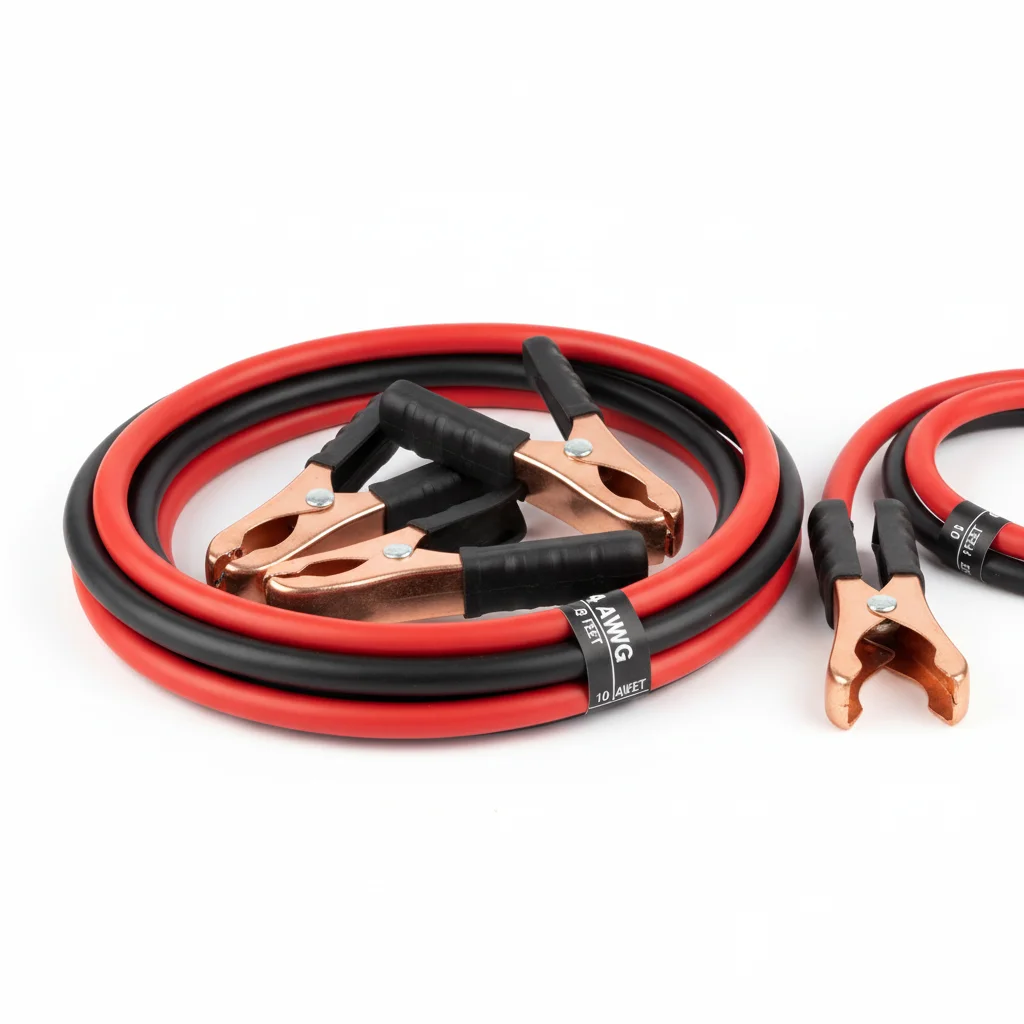
Choosing the correct gauge for your jump starter cables is crucial for both safety and effective performance. For most passenger vehicles, a cable gauge between 4 and 6 AWG (American Wire Gauge) is generally recommended. This range provides sufficient conductivity to transfer the necessary current without overheating, ensuring a quick and safe jump start.
Understanding Cable Gauge and Its Importance
The gauge of a cable refers to its thickness. Counterintuitively, a lower AWG number indicates a thicker cable. Thicker cables have less electrical resistance, allowing more current to flow efficiently. Using cables that are too thin (higher AWG) can lead to excessive heat buildup, potential damage to your vehicle’s electrical system, and an ineffective jump start. Conversely, while thicker cables are always safer, they can be more cumbersome and expensive.
Factors Influencing Your Cable Gauge Choice
Several factors should influence your decision when selecting jump starter cable gauge. The size of your vehicle’s engine is paramount; larger engines, especially V8s or diesels, require more current and thus thicker cables (lower AWG). The length of the cables also plays a role; longer cables inherently have more resistance, so a slightly thicker gauge might be necessary to compensate. Finally, the climate you operate in can be a factor, as colder temperatures can increase battery resistance, sometimes warranting a more robust cable.
- Engine Size: Larger engines (V6, V8, Diesel) demand lower AWG (thicker) cables.
- Cable Length: Longer cables may require a lower AWG to maintain efficiency.
- Amperage Rating: Match cable gauge to the peak amperage of your jump starter.
- Material Quality: High-quality copper cables offer better conductivity.
- Insulation: Durable, flexible insulation is essential for safety and longevity.
Recommended Gauges for Different Vehicle Types
|
Our Picks for the Best Jump Starter in 2026
As an Amazon Associate I earn from qualifying purchases.
|
||
| Num | Product | Action |
|---|---|---|
| 1 | NOCO Boost X GBX155: 4250A UltraSafe Jump Starter – 12V Lithium Battery Booster Pack, Portable Jump Box, Power Bank & Jumper Cables - for 10.0L Gas and 8.0L Diesel Engines |

|
| 2 | Portable Car Jump Starter with Air Compressor for Emergencies,3000A Peak and 150 PSI Max,for 12L Gas & 10L Diesel Engines,LCD Display,LED Light |
|
| 3 | Jump Starter with Air Compressor, 6000A 150PSI Car Battery Jump Starter (10.0 Gas/8.0L Diesel) Battery Jumper Starter Portable 12V Jump Box with Jumper Cables, LED Light, LED Display |
|
| 4 | Tire Inflator Portable Air Compressor with Digitally Display Pressure Gauge 20000mA, Car Air Compressor Pump with Jump Starter 150PSI, 14.8 V Car Battery Jump Starter Portable |
|
| 5 | Tire Inflator Portable Air Compressor, 12V Car Jump Starter, 150PSI & 28000mAh Air Pump with Air Blower, Digital Pressure Gauge and LED Light, Electric Air Pump for Car, Motorcycle, Balls, Bike Pump |
|
| 6 | NOCO Boost X GBX55: 1750A UltraSafe Jump Starter – 12V Lithium Battery Booster Pack, Portable Jump Box, Power Bank & Jumper Cables - for 7.5L Gas and 5.0L Diesel Engines |
|
| 7 | ANCEL BS200 Super Starter - Permanent Connected Starting System with Super Capacitor, Car Battery Jump Booster & Health Monitor via App, -40℉~176℉ in-Cabin Jump Box for 3.0L Vehicles |
|
| 8 | Roar Pedal Super Capacitor Jump Starter, No Need Pre-Charge No Battery 12V Portable Car Jump Starter for All 12V Gas and Diesel Car, Portable Jump Box with Display |
|
| 9 | KeenPower 6000A Super Capacitor Battery-Less Jump Starter, Built-in 6 * 3000F Supercapacitor, No Traditional Battery |
|
| 10 | Tire Inflator Portable Air Compressor & Car Jump Starter, Cordless Air Pump with LED Light & Pressure Gauge for Auto,Motorcycles,Bikes,Balls. |
|
For compact cars and sedans with 4-cylinder engines, 6-gauge cables are often sufficient. Mid-size sedans and smaller SUVs with V6 engines typically benefit from 4-gauge cables. For larger SUVs, trucks, and vehicles with V8 or diesel engines, 2-gauge or even 1-gauge cables are highly recommended to ensure adequate power delivery. Always check the manufacturer’s recommendations for your specific jump starter and vehicle.
Safety Considerations and Best Practices
Beyond gauge, always inspect your jump starter cables for any signs of wear, fraying, or damage before use. Ensure the clamps are robust and make a secure connection to the battery terminals. Proper connection order (positive to positive, negative to ground) is critical to prevent sparks and potential damage. Investing in high-quality cables with good insulation is a wise decision for long-term reliability and safety.
When purchasing new jump starter cables or a jump starter unit, prioritize those that clearly state the AWG rating and have positive reviews regarding durability and performance. Avoid generic, unbranded cables that do not specify their gauge, as these often use thinner, inferior materials that can pose a safety risk. A good set of cables is an essential component of any roadside emergency kit.
